
Dolores Huerta Knows Why It's Needed: 7 Ways To Maintain Fair Leadership in Culture of Silence
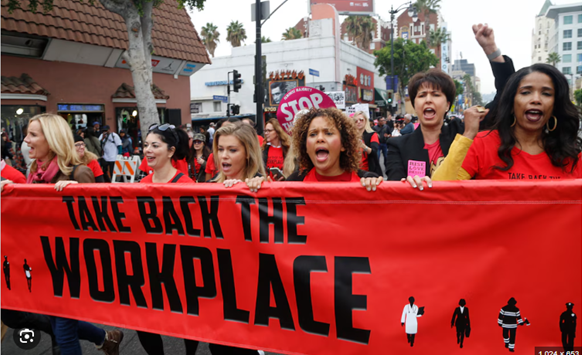
A recent protest in Los Angeles to stop workplace harassment.
The close of Women’s History Month needs to serve as a call to action for leaders in every industry to create open access and accountability for all claims of poor behaviors that compromise any and all colleagues, and women particularly.
Read more in Take The Lead on harassment in workplace
The current chapter on the handling of harassment in women’s work history is atrocious, but all accounts must be respectfully handled, disclosed and never erased. A new era of openness on interactions, behaviors and treatment must emerge.
The recent disclosure made public by civic rights icon Dolores Huerta concerning the crimes of the late Cesar Chavez toward her and many other young women is appalling, but not isolated.
“At close of #WomensHistoryMonth2026, a new era of openness on interactions, behaviors and treatment regarding harassment at work must emerge. #transparency #fairness #workplace”
Read more in Take The Lead on harassment
“When it comes to women’s equality, especially when it comes to maintaining ambition and driving women’s intentions to reach leadership parity in any industry or profession, sexual harassment and violence are not just wrong, they hold women back, plain and simple. They make us doubt ourselves, lower our self-esteem, and cause us to resist embracing the powerful woman who lives inside of each one of us,” says Gloria Feldt, co-founder and president of Take The Lead in this recent Take The Lead podcast.
“Sexual #harassment and #violence are not just wrong, they hold women back, plain and simple. They make us doubt ourselves, lower our self-esteem, and cause us to resist embracing the powerful woman who lives inside of each one of us,” says Gloria Feldt, co-founder and president @takeleadwomen.”
While it is news that many are coming forward in the Chavez case and organizations causing the removal of tributes to his work nationwide, only some of those involved in the international trafficking network of Jeffrey Epstein are seeing consequences. It has historically been necessary for business leaders and entrepreneurs to make space for reporting actions that harm and demean women. And it will always be necessary.
It is time to hold persons accountable for “behavior that does not belong in any industry or any workplace,” actress Asia Agento said in her 2018 speech at the Cannes Film Festival regarding the newly public crimes of Harvey Weinstein. At 74, Weinstein faces his third retrial following his 2020 conviction on multiple sexual assault charges.
Read more in Take The Lead on harassment firings
The enormous fallout at the top of industries from banking to academia, retail and politics very recently due to the Epstein files release is not only for men in power, but also women. Kathryn Ruemmler, Goldman Sachs's chief legal officer, was fired for her long term association, and is receiving a $25 million pay package on her exit, according to Bloomberg.
“Kathryn Ruemmler, @GoldmanSachs chief legal officer, was fired for her long term association with @JeffreyEpstein, and is receiving $25 million pay out. #accountability #leadership ”
Yes, human trafficking is extreme. But workplace harassment is commonplace in the U.S. and “remains a significant concern across industries, with research indicating that nearly 25% of employees have experienced some form of harassment during their careers. The U.S. Equal Employment Opportunity Commission (EEOC) reports that over 70,000 harassment charges are filed annually, with sexual harassment being one of the most prevalent forms,” according to Market Biz.
“Harassment remains a significant concern across industries, as data shows 25% of workers experienced some form of #harassment during careers. @EEOC says 70K charges filed a year. #workplaceculture ”
Read more in Take The Lead on harassment outcomes
Those numbers are exceptionally low, because 75% victims do not report the incidents. “Women make up 60-70% of sexual harassment victims, with 40% of women in STEM facing gender-based harassment,” the report shows.
High rates of racist harassment and bullying impacting LGBTQ workers is common.
A new report, The State of Workplace Harassment: 2026 Findings, shows that “46% of Gen Z employees say they’ve witnessed workplace harassment – and 33% report experiencing it firsthand.” The report also shows that most do not report it and for those who do, “38% say they were dissatisfied with their employer’s response.”
“46% #GenZ employees say they’ve witnessed #workplace #harassment; 33% experience it firsthand; 38% dissatisfied w employer’s response.” @traliant”
Read more in Take The Lead on history of harassment
“Let’s shift the ownership,” actress Christina Ricci recently posted on social media. “Maybe we should start talking about how many men out of three will sexually assault someone instead of how many women out of three will be assaulted.”
“Christina Ricci: “Let’s shift the ownership. Maybe we should start talking about how many men out of 3 will sexually assault someone instead of how many women out of 3 will be #assaulted.” #accountability”
Knowing the pervasive history of what has happened globally does not mean it is normal nor can it be tolerated or excused in the workplace. Many steps to create a cultural of transparency and accountability can “cure” a toxic workplace of any size and develop a culture of healthy encounters on all levels for each participant.
Read more in Take The Lead on culture change
1. Vet hires carefully. Contact formal references on a resume, but also those who are not on the resume, but who would know the individual. Check social media accounts for patterns that may be telling. Ask direct questions about the candidate’s history.
2. Have an open door policy. As a leader you can either create times of the day or week where you welcome input and comments or always have an open door. Have a literal comment box in an easily accessible area or an email address where anyone in the organization can offer input on interactions and what occurs on different levels of encounters at work.
3. Follow up. If not appropriate, do not reveal the identity of the person who commented or complained about another’s actions, but directly ask the person involved about behavior. Deliver a warning and put the interactions in writing.
4. Make behavioral expectations of respect and zero tolerance for harassment known. List the expectations on the company’s site, as well as post them in the workplace, and also say them out loud in person and on zoom for every meeting. Start the meetings with a list of “Agreements and Expectations” on behaviors, actions and tone, and ask everyone if they agree and if they warrant further discussion or suggestions.
“Make behavioral #expectations of #respect and #zerotolerance for #harassment known. List expectations on the company’s site, post them in the workplace, and say them out loud in person and on zoom for every #meeting. #workplaceculture #leadership ”
5. Model respectful behavior. Be polite and respectful and never make comments that could be misinterpreted or assumed to be discriminatory or inappropriate. If you are questioned or called out, apologize immediately to everyone involved.
6. Not all jokes are funny. Never, ever repeat or pass along a joke that is at the expense of any individual or group of any identity. “I didn’t mean it” is not a defense.
7. Bring in a third party if necessary. If a remark or incident is not resolved, definitely call on a third party to investigate. "Having a third-party team will leave an impression that the employer is taking the complaint seriously, even if it involves top management. This is also to guarantee that those involved in the hearing of the complaint will be objective and neutral," Diomdelia B. Vergara, a lawyer of the Public Attorney's Office (PAO), tells Human Resources Director Asia.
Harassment and discrimination in all their forms are part of a larger system of power abuse.
“Power abuse happens when leaders exploit their authority to demean, control or marginalize employees,” Tamanna Ramesh, founder of Spark Careers, tells Business.
“Power #abuse happens when leaders exploit their authority to demean, control or marginalize employees,” Tamanna Ramesh, founder of Spark Careers. #leadership @takeleadwomen ”
Ramesh recommends employees and leaders practice the SAFE framework: Spot the issue. Assemble evidence. Find support. Escalate or exit.
Read more in Take The Lead on systemic change
“For individuals, it means recognizing abusive behavior, documenting incidents, reporting concerns and, if nothing changes, choosing to leave an unsafe environment. For employers, it means identifying misconduct, documenting what’s happening, supporting affected employees and taking action — up to and including discipline or termination — if the behavior doesn’t stop,” Rameesh reports.
A healthy workplace values and rewards transparency, trust, empathy, attentive listening, accountability and resolution. When someone speaks up, they need to be heard and responded to.
Read more in Take The Lead on speaking up
“The power imbalance pitted against talented women” causes women “to stop seeking advancement,” Feldt says. She adds, “Sexual objectification, harassment, and all forms of violence are ‘power over’ techniques used to keep women silent and secondary,” she adds.
Read more from Gloria Feldt here
“Still, if we recognize that dynamic and consciously shift the power paradigm to the power TO prevail over, we can ameliorate the effects of those harmful experiences and we can change the culture,” Feldt says.
Three of the 9 Leadership Power Tools developed by Feldt are essential in a workplace, system or organization that has a toxic power culture. “Use the power of your voice to speak your truth and to stand up for those with less power,” Feldt explains of the first tool.
“If we recognize the dynamic and consciously shift the power paradigm to the power TO prevail over, we can ameliorate the effects of those harmful experiences and we can change the culture,” says Gloria Feldt, @takeleadwomen cofounder, president. #womensleadership #strategies #power ”
Read more about the 9 Leadership Power Tools course
Secondly, “Listen to the voices of women and let them know they are heard and believed,” Feldt says. And third, “Don’t agonize; organize to make systemic change.”
Learn more here and register early for the Power Up Conference 2026 on Women’s Equality Day.
