
Always Prepare: 10 Ways To Improve Your Leadership With Public Speaking Cred
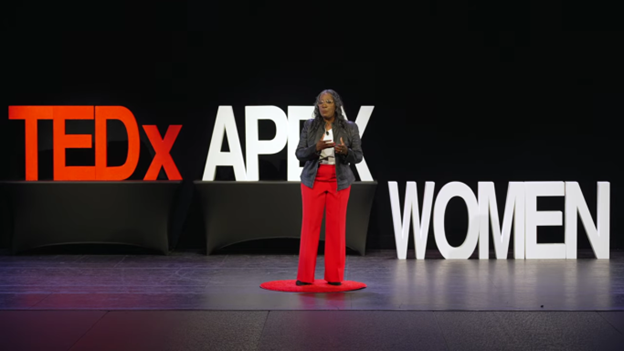
Michelle Edelen in a recent popular TEDx talk.
A surefire and well-deserved way to rise as a leader is to consistently speak eloquently in meetings, conferences and public events. That means being competent and prepared, so whether you are standing on stage at the microphone or called on at a board meeting, you will come off polished and well-spoken.
You do not want to be like actress Sarah Snook who accepted her Critics Choice Award recently, with this ramble,” Yeah, I just had forgotten what we were doing, and I didn't write a speech or anything, and I'm just trying to go through some things now."
Nope.
Even if you are initially fearful of speaking up and speaking out, know that these 10 insightful tips can augment your treasure chest of powerful strategies to refine your leadership skills in 2026.
Read more in Take The Lead on public speaking tips
If you are asked to be a guest on a radio or TV show, podcast, conference panel, invited to deliver remarks at a monthly meeting, or even a casual business dinner celebration, say “yes.” Demonstrating repeatedly that you are eloquent, calm and offer brilliant takeaways is not just advisable, it’s a must.
Chances are you will be recognized as someone who can handle high level communication in a pinch and offer representation so your rise to the top can go swiftly and more smoothly. Being the organization’s reliable spokesperson is a very good attribute.
“If you excel at #publicspeaking, chances are you will be recognized as someone who can handle high level communication in a pinch and offer representation so your rise to the top can go swiftly and more smoothly. @takeleadwomen #leadership ”
Her Agenda reports, “A recent study by the National Association of Colleges and Employers revealed that 80% of employers prioritize verbal communications skills when hiring.”
Knowing your history and telling your story are part of Take The Lead’s 9 Leadership Power Tools as created by Gloria Feldt, co-founder and president of Take The Lead. Feldt advises, “Speaking up in the public square also takes courage. The courage to raise the issues. To use the power of your voice to overcome the pushback from those who say it can’t be done, or those whose best interest lies in your not being able to do it.”
“To use the power of your voice to overcome the pushback from those who say it can’t be done, or those whose best interest lies in your not being able to do it.”—Gloria Feldt, cofounder, prez @takeleadwomen #leadership #speakup”
Your voice is a power tool to use in embracing your leadership acumen.
As a TEDx speaker who has delivered more than 100 keynotes, a frequent media guest, and facilitator of conference panels, I emphatically advise to never, ever speak “off the top of your head.” And cure yourself of the “um problem.” Train yourself not to say um or like, by taking a pause of silence and continuing. Otherwise, you risk your reputation professionally and will likely not be asked to return as a speaker. A speaking career on the side can prove lucrative as well as an expression of your leadership abilities.
Here are important steps to becoming a better public speaker.
1. Research, prepare. According to In Her Sight, “Few skills strike as much fear, or spark as much growth, as public speaking. More than a third of women (34 percent) in our audience say they feel uncomfortable or very uncomfortable with it, while only about one in four describe themselves as very comfortable. Even the most seasoned speakers will tell you it takes practice, courage, and a whole lot of trial and error to find your voice.”
So whether you propose the topic or are given a topic for your presentation, research it mightily for news updates, historic context and analysis. Add popular culture references to pull your audience in, and that includes quotes from movies, songs, books, social media. You want to have a bounty of information to choose from so people learn from you and you are not repeating old news.
“Whether you propose the topic or are given a topic for your presentation, #research it mightily for news updates, historic context and analysis. #publicspeaking #leadership #skills”
2. Write a script. A friend who was recently preparing for a presentation to a large international group, complained it was taking so long to create the Power Point to accompany her talk. I advised, “Go through your outline for the script and see what illustration or main points can be pulled out roughly every four to five minutes.” She scoffed. “A script? Never. I know what I am talking about.”
Let me just say you cannot ever just wing it. You want to outline it with the introduction, main points, examples, research and evidence, anecdotes, and a conclusion. Type it up, knowing that every page of script with 12-point type, double space, is about one minute of speaking. According to TLC Worldwide, “It is crucial to have a clear and engaging message. This involves identifying key points, planning the structure of our speech, and ensuring that our delivery tells a story. Even if the topic seems mundane, effective storytelling can make a significant difference in capturing the audience’s attention. Relatability is also key, as we must connect with our audience and make them resonate with our message.”
Read more in Take The Lead on telling your story
3. Learn about your audience. Even if your talk is on the same topic, a group of college students react and relate differently to information than a room of CEOs. Gather information about the demographic, numbers, who has spoken for this group before, what time you are on the roster. A post-breakfast talk differs from an end-of-the day talk. Reference where people are from, ask ahead of time about the attendees and their titles and back stories. Find out if this is a group of alumni who know each other, or a group of employees at an international firm of thousands who have not met before.
“Treat your audience like guests in your home. Ask rhetorical questions. Mention someone in the crowd if it feels right (‘You’re nodding—you know what I’m talking about, right?’). Those small moments of connection elevate your message,” according to Forbes.
“Do the research. Gather information about the demographic, numbers, who has spoken for this group before, what time you are on the roster. #publicspaker #keynote @takeleadwomen”
4. Have an unforgettable opening. If you start with a long bio, people will stop listening quickly. Start with a question, Tell a joke (and make sure there is absolutely no way it could be offensive to anyone.) State a surprising fact. Involve the audience immediately, stating something that happened at the conference or that morning.
“The difference between good and great is a universal truth. It’s a moment when you understand the big story within a little story. You reflect humanity back to humanity,” says Arlene Malinowski, co-author of the book, Solo: The Everything Guide to Writing, Performing and Producing Your One-Person Show.
Read more in Take The Lead on Arlene Malinowski
5. Create original phrases that are sharable bytes. In her TEDx talk, “The Power To Shape Your Destiny,” Michelle Edelen repeats the phrase, “Seize every good opportunity,” multiple times, making it the banner takeaway for her talk, that is accessible and memorable. What can you create that names a process or identifies your original idea in a minimum of words that can become your tagline?
Join Take The Lead’s Open House 1/13, 5 p.m. ET to make 2026 your best year yet. Register here.
6. Vary sentence length. This may sound odd, but the cadence of your speech is what can make it memorable. Longer sentences balanced with tight, brief responses. Briefly worded questions followed by pauses and met with a minimum of words, then a longer explanation. “Vary Your Tone and Pace: Avoid monotony by emphasizing key words and pausing for impact,” according to LinkedIn. To do that, you need to read your script out loud and notice if there are two lengthy sentences together or a long paragraph that is not broken up with shorter phrasing. Speak too briefly, your talk seems brittle, speak with loquacious wording and people will fall asleep.
Read Power To Change Stories in Take The Lead
7. Project confidence: Speak loudly enough to be heard at the back of the room, of course, but do not shout. Stand with your back straight, look around the room as you speak and do not read from the script the whole time with your head down. Many spaces offer to have your speech on your teleprompter, or you can have notecards with the main points of each paragraph highlighted briefly. This is why practicing is so important, because you will either have it memorized or you will be able to speak it boldly with assistance from the script or notecards, or even your phone. CIO Women advises, “When you are on stage it is quite obvious that you are feeling nervous. But if you express it with your facial expressions then you might lose yourself. Keep a big smile, stand tall, make eye contact, and have your space. Take a deep breath before going on stage. Your voice is your identity” and your opening tone will engage the audience. Start with a clear and confident voice. “
Read more in Take The Lead on the power of storytelling
8. Have memorable visuals. When appropriate, great visuals and sometimes additional audio of music or video snippets can accompany your talk, but definitely nothing that will distract from your words. You want no slide with more than 10-15 words tops. And nothing that competes with what you are saying. It can be a key phrase you repeat, or you can have a single photograph that is the backdrop for your talk. “Visual aids, when used correctly, can significantly enhance your presentation. Use slides, videos, or infographics to support your message but avoid overcrowding them with text. Engage with your visuals actively during your presentation to help maintain audience focus and interest,” Big Money Speaker reports.
“When appropriate, great visuals and sometimes additional audio of music or video snippets can accompany your talk, but definitely nothing that will distract from your words. #publicspeaking #leadership #audience #skills”
Read more in Take The Lead on Carla Harris
9. Be authentic. Whether you tell a true story that makes you vulnerable or you present anecdotes and stories of others with empathy, an audience can assess if you are performing or if you are for real. Her agenda reports, “Authentic leadership — when you’re transparent, compassionate, and take accountability — has been found to have a positive impact on teams (and people in general) when it comes to performance, fulfillment, and dynamic action. We see this on social as well, where ‘imperfect is the new perfect’ and authenticity sells. Popularly successful public speakers like Lisa Nichols, Oprah Winfrey, Carla Harris and Brene Brown have all spoken to the power of being yourself and leaning into your own truth, whether it’s in how you speak, how you show up, or your unique outlook on something.”
Read more in Take The Lead on public speaking as a power
10. Close strongly. Perhaps ask a question for the audience to ponder, or make a dramatic statement about goals and projected outcomes. You don’t just want to stop talking and then say the equivalent of , “That’s all, folks,” and walk off the stage. Go back to the beginning, tell another anecdote, answer a question you posed, or deliver a memorable look into the future. There are several apps available to help you with public speaking, including a powerful conclusion.
CIO Women reports, “Public Speaking is not just about giving a speech in public, it’s about making an impact through your speech. Strong communication skills can open many doors of opportunities like leadership, give career advancement, and greater influence in your professional and personal space.”
“Be authentic: Whether you tell a true story that makes you vulnerable or you present anecdotes of others with empathy, an audience can assess if you are for real. #authentic #leadership @takeleadwomen”
