
Suffs & Thoughts: When History Becomes Urgent
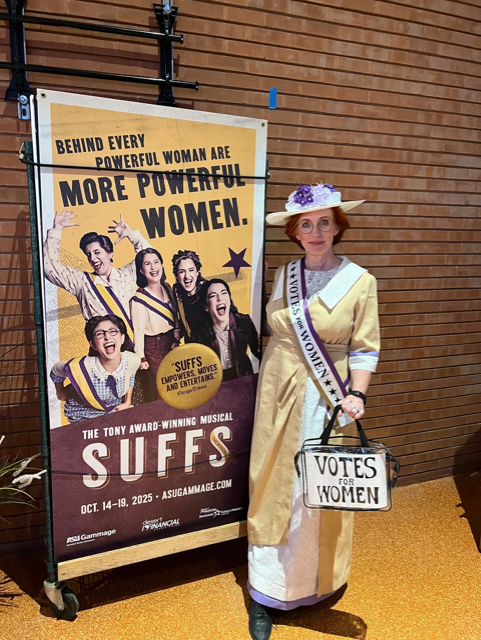
Wonder Wendy Farrelll in her suffragette outfit recently for the production of “Suffs.”
By Wonder Wendy Farrell
There are moments when history reaches forward and taps you on the shoulder. Not softly, not politely, but with a kind of steady insistence — a reminder. A reminder that progress is not permanent, rights are not guaranteed, and the work of shaping a more just world is ongoing. That’s how I felt sitting in the theater at Arizona State University Gammage a couple of weeks ago, watching the touring production of Suffs, the musical about the women who fought — relentlessly — for the right of women in America to vote.
Here I am, weeks later, still thinking about it. Still talking about it. Still feeling it move inside me. At its core, Suffs delivers one unmistakable message: there is still work to be done.
Growing up, I remember the suffrage movement being treated like a footnote in history class. A brief chapter, a neat conclusion: “Women gained the right to vote in 1920 with the 19th Amendment.” Full stop. Done and dusted. What Suffs does so vividly — so powerfully — is refuse to let that version stand. It pulls back the curtain on the reality: that this was not polite, orderly, or universally supported progress. It was hunger strikes. It was jail cells. It was women being beaten, mocked, force-fed, and dismissed as unwomanly, dangerous, hysterical. It was strategy, stamina, fracture, reconciliation, and sacrifice. Women did not receive the vote. Women fought for it.
It wasn’t “lady like” it was a fight left marks — on bodies, on relationships, on the soul of the nation — marks we rarely acknowledge.
Before the show even began, there was this sense of standing inside a moment that bridged past and present. I attended a pre-show reception marking Arizona’s role in the upcoming 250th anniversary of the United States. I met Phoenix Mayor Kate Gallego — kind, grounded, deeply engaged — and then, on the mainstage, Governor Katie Hobbs delivered a proclamation honoring the legacy of the suffragists and Arizona’s contributions to women’s rights. It didn’t feel performative. It felt like history echoing forward, calling us to pay attention.
I wore my suffragette outfit that night — 1917 dress in the colors of suffrage, sash, and a sign proclaiming, “Votes for Women”. I felt like I was wearing the memory of the women who came before us. Not in costume, but in gratitude. Amplifying their message and bringing it forth to a new generation.
When the lights dimmed and the show began, I was hit — not with nostalgia — but with urgency. These women were not saints. They disagreed, they collided, they pushed and challenged one another, but they were united by something larger than ego: a belief that they were not asking for something new, they were insisting on something inherent. Their humanity.
We like to believe the story ends in 1920. It doesn’t. It didn’t then, and it doesn’t now. Rights can be won and eroded. Progress can move forward and backward. The door they forced open is still one we must actively hold.
So when I say, There is still work to be done, I am not making a political statement — I am naming a truth. We are still living in a time when women’s voices, bodies, autonomy, leadership, safety, earning power, and influence are contested. The theater reminded me: the question is not whether progress happened. The question is whether we are continuing it.
If Suffs comes to your city — go see it. Take the people you care about. Take the people who think they already know the story. Take the ones who don’t yet realize they are part of it. Allow it to stir something. Let it open a conversation you’re ready to have, even if you didn’t know you were ready.
The women who came before us held the line.
Now it’s our turn to carry the work forward.
With love and wonder,
Wonder Wendy
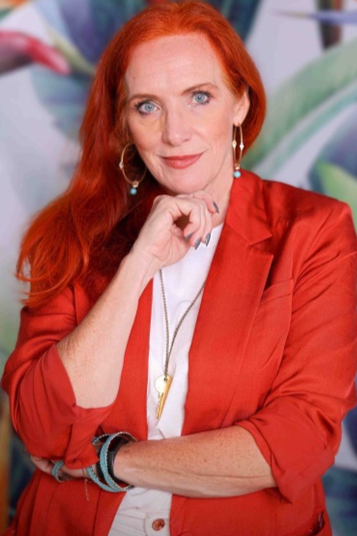
Wonder Wendy Farrell is a speaker, storyteller, and podcast host who helps women in midlife reclaim their voice and live with greater wonder, courage, and self-trust. Through her podcast The Imperfect Prophet, she invites audiences to embrace imperfection as a source of power and to expand into a life that feels authentic, meaningful, and alive.