
Are You Dreaming Big Enough? Valerie Jarrett On Finding Your Voice
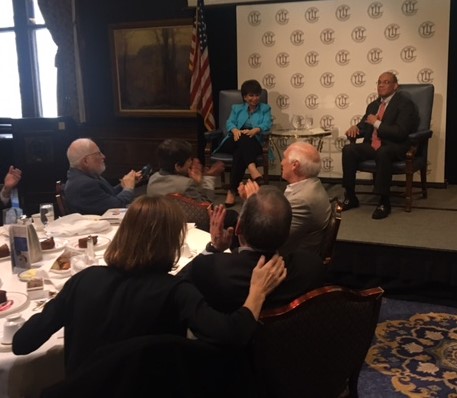
Valerie Jarrett, left, in conversation with John Rogers, Jr., on finding your voice.
Valerie Jarrett says when she set off for her first year at Stanford University in 1974, her mother gave her a warning.
“She calculated how much every class cost, and said if you are thinking about cutting a class, this is how much is coming out of my pocket,” says Jarrett, chairman of the board of When We All Vote; co-chair of the United State of Women, senior advisor to the non-partisan Obama Foundation and senior distinguished fellow at University of Chicago Law School.
Speaking recently to a crowd of more than 300 at The Union League Club in Chicago, in an interview with John Rogers Jr., founder, chairman and CEO of Ariel Capital Management, Jarrett says her mother, Barbara Jordan, who is co-founder of The Erikson Institute, always told her to “do something to be useful.”
The author of the new book, Finding My Voice, Jarrett says her parents would always ask her, “Are you working hard enough? Are you dreaming big enough?”
As Jarrett serves on the corporate boards of Lyft, USG Corporation, Ariel Investments, the Museum of Science and Industry, and is chair of the boards of Chicago Stock Exchange, University of Chicago Medical Center and Chicago Transit Board, the former senior advisor to President Barack Obama, has most certainly followed her mother’s directive.
Read more in Take The Lead by Gloria Feldt on engaging in civic life
“All roads lead back to my parents,” says Jarrett, whose late father, James Bowman, was a pathologist and geneticist. “I was well-loved, nurtured and they set high expectations. My father told me I can do anything I want.”
Born in Iran because her father worked at a children’s hospital there, then moving to London at 5, before the family moved to Chicago where her father worked at the University of Chicago, Jarrett says living globally helped shape her.
Spending time in underdeveloped countries means, “I can walk into a room and find something in common with anyone.”
She adds, “Often people who have not lived outside the U.S. do not appreciate our country as much as they should. The U.S. is already the greatest country on earth, but not the only country on earth.”
After graduating from Stanford in 1978, Jarrett went to law school at University of Michigan, a move her mother applauded, “because otherwise she said I would be selling girdles in the basement of Marshall Field’s.”
After working a few years in corporate law, Jarrett says at 31, in an unhappy marriage and with a young daughter, Laura, she decided to change her life.
“I used to go back to my office with a view of Lake Michigan, turn my back to the door and close the door because I didn’t want anyone to see me cry.”
Jarrett took the leap into city government in Chicago because a friend told her “you will feel part of something that is bigger than yourself.” She adds, “That helped me to find the most important voice of all, the one that is inside of you.”
Read more in Take The Lead on women in politics
Gloria Feldt, co-founder and president of Take The Lead, would agree finding and using your voice is essential as a leader. Her Leadership Power Tool #8, “Employ every medium,” advocates for using your voice. “Use personal, social, and traditional media every step of the way. Use the medium of your own voice. And think of each of the power tools as a medium to be pressed into the service of your ‘power to’” create change.
“@GloriaFeldt, co-founder and president of @TakeLeadWomen, advocates for using your own voice in her #LeadershipPowerTool #8: Employ every medium.”
Serving in city government under two former Chicago mayors, then going on to become CEO of the Habitat Company, Jarrett says, “Part of being a leader is learning how to absorb pain. You don’t become numb to it or annoyed by it.”
“According to @ValerieJarrett, part of being a #leader is learning how to absorb pain. You don’t become numb to it or annoyed by it.”
Divorced when her daughter was young, Jarrett says, “Being a single mom and seeing how hard it was for me—with means and living near my parents, with the resources to afford childcare, I still felt I was hanging on by my fingertips,” says Jarrett.
“So I was thinking how to focus on gender equity for working families to have a fair shot and to improve the lives of women and girls, “ says Jarrett, who was chair of The White House Council on Women and Girls. “We wanted to help women become entrepreneurs and improve the access to capital.”
As the longest serving senior advisor in the Obama administration from 2009-20017, overseeing the offices of Public Engagement and Intergovernmental Affairs, Jarrett says she noticed that women on the White House staff were not speaking up in meetings and were not always listened to.
Read more in Take The Lead on women running for office
“Some of the women, their voices were shrinking,” says Jarrett. “Many women express that in places of business you make a comment and no one pays attentions and 10 months later, a man says it and he is applauded. “
Jarrett says she called together the women on staff for a dinner with the president and he said, “I need to hear your voices. You have to fight for your perspective and your ideas. “
She adds that the gathering of women staffers became a regular event. “We told each other our stories. It created a bond of trust,” Jarrett says. “Not only did we feel individually brave but we supported each other.”
“.@ValerieJarrett says the women on staff told each other their stories. ‘It created a bond of trust... We supported each other.’”
The practice of women not speaking up at meetings is decades old, and still prevalent, according to Harvard Business Review. And it needs to change.
Jill Flynn, founding partner of the consulting firm Flynn Heath Holt, in the HBR podcast, “Women at Work: Make Yourself Heard,” says, “We say that meetings are really like the corporate stage. It is where you get to be seen and heard and evaluated. And we’re not taking that seriously. So, if we are trying to get approval for something, or we are trying to get a peer to join in and follow because as leaders, what we’re trying to do is make changes in our organizations. “
HBR associate editor Nicole Torres adds, “And I think the last thing we want are just more people speaking over each other. What we really want is people learning how to speak up with ideas and also how to give people room to voice their ideas, too.”
At the Union League event, only days earlier in Chicago, where Jarrett spent most of her professional career, Lori Lightfoot, a gay woman of color, was elected Mayor.
“For the first time in the city’s history, black women will hold the top political offices in the city and county: Mayor-elect Lori Lightfoot, Cook County Board President Toni Preckwinkle, Cook County State’s Attorney Kim Foxx and city Treasurer-elect Melissa Conyears-Ervin,” writes Mary Mitchell in the Chicago Sun-Times.
According to Rutgers University Center for American Women and Politics, “In 2019, 127 women serve in the U.S. Congress. Twenty-five women serve in the Senate and 102 women in the House. The number of women in statewide elective executive posts is 86, and the proportion of women in state legislatures is 28.8 percent.”
Read more in Take The Lead on women in politics
Rutgers also reports, “86 women hold statewide elective executive offices across the country; women hold 27.6 percent of the 312 available positions. Among these women, 46 are Democrats, 38 are Republicans and two are non-partisan.”
In state legislatures, “2,126 or 28.8 percent of the 7,383 state legislators in the United States are women. Women hold 508 or 25.8 percent of the 1,972 state senate seats and 1,618 or 29.9 percent of the 5,411 state house seats. Since 1971, the number of women serving in state legislatures has more than quintupled, the center reports.
As she writes in her book, “Too often we can tread water for so long in our misery that it becomes the new normal. As a young woman, even after I was married, when I was unhappy, I hesitated to speak up. I avoided risks and rocking the boat. I felt like I was leading someone else’s life, deferring to the chorus of voices around me rather than heeding the quiet one deep within. “
Jarrett writes, “I learned not only how to trust my own voice and act on what it was telling me, but also how to use my voice to advocate for change and progress.”
We want you to be a part of the Take The Lead community: Connect with us on Twitter @takeleadwomen. Find out more here on our 50 Women Can Change The World programs. Subscribe here to our Take The Lead weekly newsletter. Join us on LinkedIn.
About the Author
Michele Weldon is editorial director of Take The Lead, an award-winning author, journalist, emerita faculty in journalism at Northwestern University and a senior leader with The OpEd Project. @micheleweldon www.micheleweldon.com