
Fix It: Leadership Solutions on Caregiving, AI, Financial Success
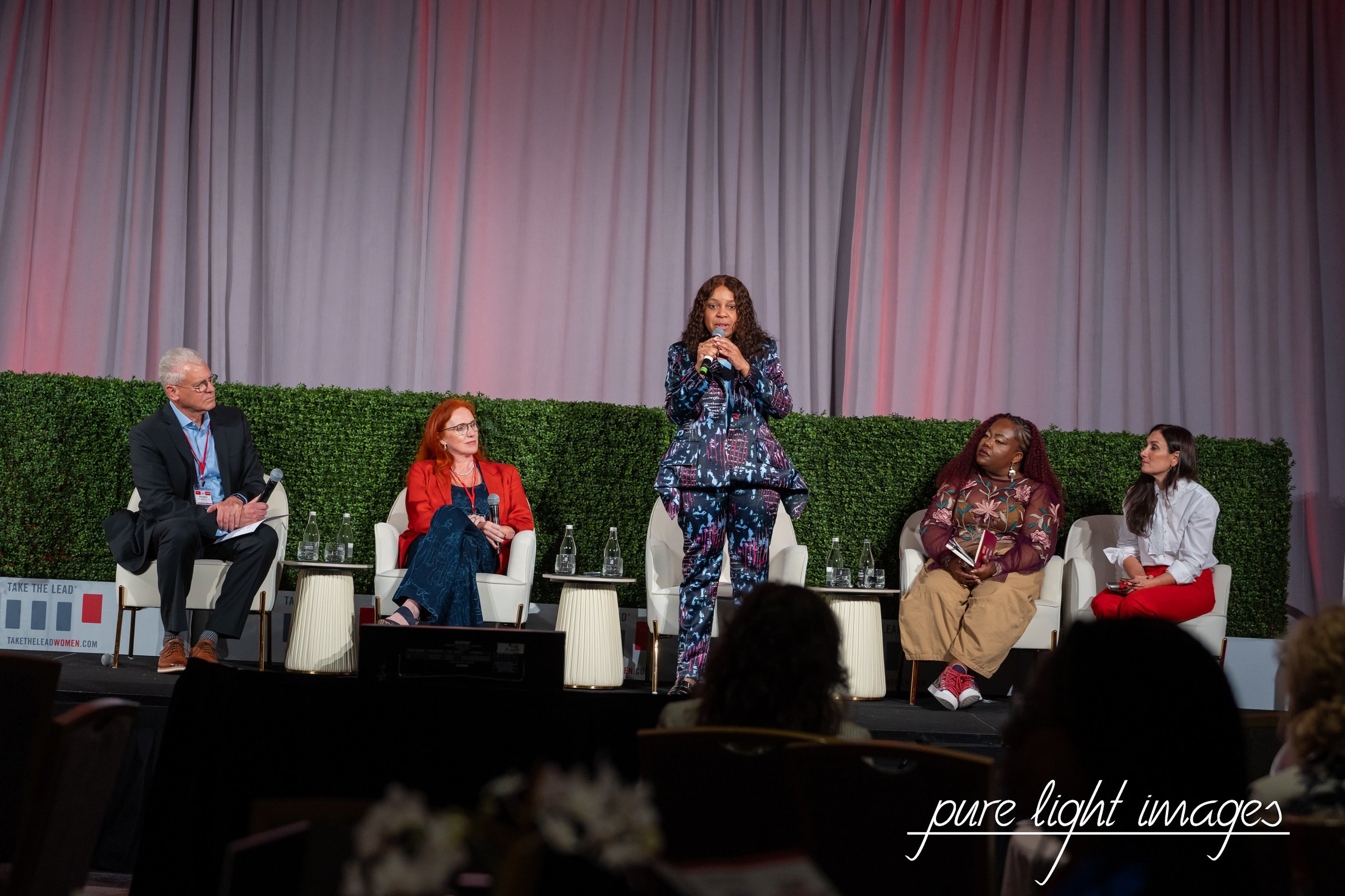
Power Up Conference 2026 L to R: W. Brad Johnson; Wonder Wendy Farrell; Dr. Grace Alexis; Leseliey Welch; Lauren Brody.
“The workplace is broken.”
W. Brad Johnson, founder and CEO of Workplace Allies, told a crowd at the recent Take The Lead Power Up Conference with great certainty that how caregivers eho are employees are treated must change.
“ The workplace is broken,” says W. Brad Johnson, founder/ CEO @WorkplaceAllies @takeleadwomen ”
Moderating the panel, “The Power of Care: Women Leading at Work and at Home,” Johnson said, “More than 73% in society identify as caregivers and we struggle with archaic norms. It is not an issue of ambition, it is a choice for self-preservation,” said the co-author with David Smith of Fair Share: How Men and Women Can Create a More Equitable Workplace Together; Good Guys: How Men Can Be Better Allies For Women In The Workplace; Athena Rising: How and Why Men Should Mentor Women.
Read more In Take The Lead on W. Brad Johnson
The notion that caregiving for elders, children, persons with disabilities or other dependents is assigned to only one gender—women—is antiquated and a dangerous impediment to fairness and equality at work, said Johnson, who earned the 2025 Take The Lead Leading Man Award.
“Caregiving is not the detraction to people’s careers. People are more motivated to move up because they have children,” said Lauren Brody, CEO of Fifth Trimester. “For every $1 employers invest, they get $8 back in performance from that employee,” said the co-founder of The Chamber of Mothers.
“#Caregiving is not the detraction to people’s careers. People are more motivated to move up because they have children,” said Lauren Brody, CEO @FifthTrimester”
Read more in Take The Lead on Lauren Brody
The National Partnership for Women and Families report, “New data from the 2025 American Time Use Survey finds that Americans spend an average of 234 hours a year caring for and helping family, friends and loved ones. If Americans’ unpaid care work was compensated at the rate of our professional care workforce, it would be worth more than $1.1 trillion a year – equivalent to 3.6 percent of the GDP.”
It is women doing the largest share of this work. The report continues, “Across all racial and ethnic groups, women spend more time on unpaid caregiving than men. On an average day, Latinas spend the most time caregiving – more than one hour, followed by white women (49 minutes) and Black women (32 minutes). People spend most of their caregiving time taking care of people who live with them, primarily children. Men spend about half of their unpaid care time taking care of children who live with them. Women spend 62 percent of their unpaid care time on household children.”
“There is a large population of single parents who were misunderstood, underrepresented and carrying responsibilities many of us could not imagine,” said Grace Alexis, Chancellor at Generations College. “And there is a lot of stigma.”
“There is a large population of single parents who were misunderstood, underrepresented and carrying responsibilities many of us could not imagine,” said Grace Alexis @GnerationsCollege #caregiving ”
Generations offers free tuition to single parents nationwide as “the largest program of its kind in the world,” said Alexis. “There are 14 million single parents in this country with 23 million children and the majority of single mothers are age 30 and up,” said Alexis.
These are women—are men—who have great potential and need to be recognized for their abilities.
As a leader, Alexis said, it is up to you to answer for the employee: “1. Do you see me? 2. Do you understand whaqt concerns me? 3. Do you care about what happens to me? And if you do, what are you going to do about it?”
Recent research from MIT Sloan Management Review shows that the attributes of caregiving have monetary value in the workplace. “Caregiving cultivates the very abilities many employers say they need most right now: empathy, problem-solving, adaptability, and leadership under pressure. The takeaway is clear: Retaining your caregiver employees isn’t just good for equity and morale; it’s advantageous to your organization. Studies show that organizations with a higher representation of women have lower turnover, stronger team performance, and greater profitability. For example, moving from no female leaders to 30% female representation in top roles is associated with a gain of roughly 1 percentage point in net profit margin, which is equivalent to about a 15% increase in profitability for a typical company.”
Wonder Wendy Farrell, performer, advocate and spokesperson, agreed. “When you make assumptions about caregiving, it leads to false conclusions. We need to stop making this a woman’s issue. We should be expecting men to the caregivers too.”
“When you make assumptions about #caregiving, it leads to false conclusions. We need to stop making this a woman’s issue. We should be expecting men to the caregivers too,” said Wonder Wendy Farrell @takeleadwomen”
Read more in Take The Lead from Wonder Wendy Farrell
Farrell added, “It’s an economic problem and a workforce problem.”
Leseliey Welch, CEO and co-founder of Birth Center Equity, said, “We build organizations with love at the center. Leaders building business do not lead alone,” she said. “How love shows up in your leadership, that is when the ROI is truly there.”
The Human Side of AI Needed
It is impossible to have any discussion of leadership, the workplace, equity and the economy without examining the intersection of AI on all aspects of work and how to maintain the urgency for human intervention.
A new Culture Amp report, How Employees Really Feel About AI at Work, of 112,000 workers globally shows “85% of employees are being encouraged to use AI in the workplace. Yet, 42% don’t know why AI is being used in the first place, raising questions about company strategies with the technology.’ Tech Radar reports.
At the recent Power Up Conference on Women’s Equality Day, “Audacity: Leadership in Action,” Stacey Engle, CEO of Twin Protocol, and member of Take The Lead’s board of directors, moderated the panel ,“The Human Advantage: AI Risks, Representation & Real Solutions.”
Read more in Take The Lead on Stacey Engle
Many approach AI with dependence, Engle said. “Help me think, help me create, help me decide and act on my behalf.” She added, “The human advantage is judgment and accountability.”
“ The human advantage (over AI) is judgment and accountability,” said .Stacey Engle, CEO @TwinProtocol #AI leadership”
Wanjiku Kamau, founder and CEO of Teal Bridge, said, she guides her use of AI with the “Times Square test.” She added, “I never put any medical records in and I only input material I would feel comfortable about having on a billboard in Times Square.”
Read more in Take The Lead on Wanjiku Kamau
Kamau, author of Out of the Loop, Into the Algorithm: How I Finally Made Friends With AI, told the audience, “I knew I had tools at my disposal. I don’t know what I don’t know, so I invest in myself.”
Read more in Take The Lead on AI
Ellie Wu, Founder & Executive Advisor of· CSuiteCX,said, “You only get the value of the work when you train these systems to think like you.” She added, “These systems are not neutral. So how do we make sure our work stays visible?”
A new BCG report shows the ubiquity of AI use and the need to create a human strategy around it.
“A breakthrough 74% of frontline employees are now regular AI users. Of frontline workers, the 42% who are regular AI users report saving a workday each week. And more than two-thirds of all employees of all types say AI has taken over simpler tasks, leaving them with more complex work.”
“74% of frontline employees are regular AI users. 42% report saving a workday each week. #AI #workplace #leadership”
Rachel B. Lee, co-owner and founder of YOUmanize, said people must acknowledge the human advantage. “Use your voice intentionally and responsibly.”
Relinquishing control to AI is not the answer. Engle said, “You training data is how we can help to mold AI as a new layer of capability. With it we can create much more impact. “
The 2026 BCG study supports this approach. “AI’s ‘joy paradox] means that it makes work both better and harder. More than two-thirds of regular AI users report more job satisfaction since using the technology, particularly leaders. And 41% of all respondents—and 48% of leaders—report increased mental strain associated with using it. The same actions that drive business impact also help employees thrive, including when a company acts in a way that aligns with its messaging about AI, tracks AI’s value, and involves people in AI ideation.
Kamau added, “If you are scared, start small.”
Pay Gap Adds Up
“Invest in Herself: Women, Money & Long-Term Success,” was a dynamic conversation at the conference exploring how women are redefining financial success, building wealth on their own terms, and using economic power as a catalyst for leadership and long-term impact.
Avis Jones-DeWeever, principal of Nouveaux Strategies, said her long career in leadership, advocacy and 10 years as an entrepreneur show her “The challenges we are facing now as women are generational challenges and progress is taken back.”
Read more in Take The Lead on Avis Jones-DeWeever
According to The Census Bureau, “One data point to keep an eye on is the wage gap between men and women, which has been widening since 2023.”
She added, “When you have years of pay inequity, it is very hard to get caught up. We are seeing repression in that area, with backlash against DEI. But there are opportunities. Think about different partnerships to develop,” Jones-DeWeever said. “You are not going there by yourself, but going with others at the same time.”
“ When you have years of pay inequity, it is very hard to get caught up. But there are opportunities. Think about different partnerships to develop,” said Avis Jones-DeWeever. #entrepreneurship #investment ”
FairPlay reports, “Women working full-time year-round earned 83.9 cents for every dollar earned by men in 2025, up from 80.6 cents in 2024, according to the Institute for Women’s Policy Research (IWPR).
For all women with earnings – including those working part-time or part-year – the ratio also improved, from 75.3 cents to 77.5 cents for every dollar earned by men. But behind those headline gains, racial disparities remain stark. Black women working full-time year-round earned just 63.8 cents for every dollar earned by a White man, while Latina women earned 59.8 cents.”
The study shows, “IWPR estimates Black women will not achieve pay equity until 2230, while Latina women could wait until 2156. That equates to more than six generations for Black women and nearly four generations for Latina women.”
Barriers exist, but entrepreneurial success is attainable.
Instinct, innovation, intelligence and self-understanding are crucial elements to financial success, Jones-DeWeever said. “Trust the thing you do best. Understand what comes easy for you. But don’t give away your gold.”
“ Trust the thing you do best. Understand what comes easy for you. But don’t give away your gold,” said Avis Jones-DeWeever @takeleadwomen #PowerUp ”
Vanessa Coppes, Founder & CEO of BELLA Magazine, says drive and initiative are crucial to financial success. “Ther concept of making my own own money was very important to me. Financial independence can get me through anything in life.” She added, “Money is energy.”
Taking initiative is critical. “If you don’t do it for yourself, no one will.” For context on the creation of the magazine, Coppes said, “Only one in five Latinas are at the helm of media companies. “
Growing up in a tiny island in the Caribbean, Coppes said, “I knew I was meant for something more. But the betting on myself no one else would do for me.” She added, “You are the prize. “
Coppes described her first board of directors meeting for the magazine. “When I took ownership, I went to a board meeting with my eight-month-old.” She changed the dynamic of the leadership. “It’s not just about getting, it’s about giving.”
She added, “What people come to you for is what you should be monetizing.” She addressed the audience directly and said, “Do what you said you were going to do. Put what you took out of a day like today and put it into action.”
