
She Put On A White Mask So AI Could See Her
Issue 2899 -October 6, 2026
A Black woman at MIT had to cover her face with a white mask before AI would admit she had one.
Her name is Joy Buolamwini. She was a graduate student at the MIT Media Lab, working with face-detection software that could not find her. When she held up a white mask, it could. She didn't shrug and move on. She investigated, and later told the story in her book Unmasking AI. I highly recommend it. I met her briefly when the book came out. I have not stopped seeing that mask.

I have spent my life watching doors open and slam shut. I have fought for women's control over our own bodies and for our rightful place in leadership. Now I believe artificial intelligence may be the most consequential issue women face for their present and future. It is reaching into abortion information, access to justice, business financing, hiring, our economic standing.
Buolamwini and Timnit Gebru measured the problem. In their 2018 Gender Shades study, three commercial systems that classify gender from faces misjudged darker-skinned women up to 34.7 percent of the time. The worst rate for lighter-skinned men was 0.8 percent. Those were specific systems at a specific moment. But someone declared that technology a success without asking whom it failed.
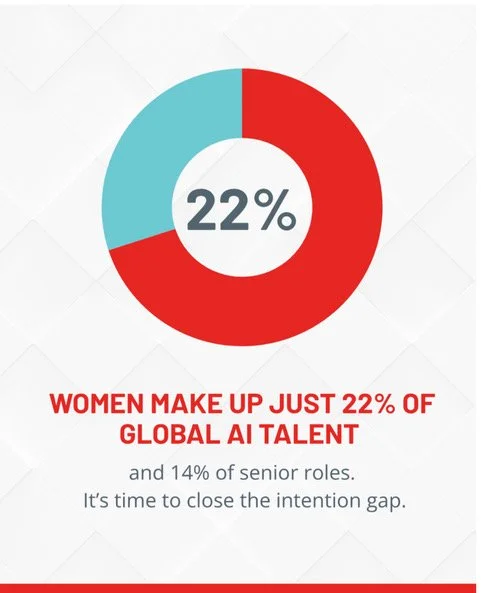
Who is in the room? Women are about 22 percent of the world's AI talent and fewer than 15 percent of its senior AI executives. Among 39 AI companies studied by Russell Reynolds, an executive search firm, women held about 30 percent of leadership roles but only about 10 percent of the CEO and top technology jobs. Four companies had all-male leadership teams. Where women did hold executive seats, they clustered in HR and legal, not in product, engineering and science. Both studies count only gender. How the picture looks for Black, Latina and Indigenous women is measured even less, and that silence is its own warning.
It is an old story. Brilliant women since Ada Lovelace build the thing, then get written out of its history while others collect the credit, the titles and the funding. The mask is a picture of that erasure as well. Without intervention now, AI will scale it.
AI learns from the record of our world, inequalities included. A record of who got a loan does not say who deserved one. A record of who became a chief executive does not name the qualified women who never got the chance. Amazon built a hiring tool trained on a decade of mostly male résumés, and it taught itself to mark down any résumé containing the word "women's." Amazon scrapped it after the potential damage had been called out as a warning. That took human oversight. Feed the past into a machine and you risk teaching it to treat yesterday's exclusions as tomorrow's good judgment.
The evidence keeps coming. UNESCO found one language model linking women to domestic roles four times as often as men. LinkedIn’s analysis with UN Women concludes that women are significantly more exposed to potential job loss from AI changes in the workforce than men. Exposure is not the same as job loss, but women must have real power over how work changes.
And there are other, more personal ramifications of what happens when people use AI. I want a woman seeking health information to get accurate answers without exposing her most private decision. I want a survivor's account weighed by people who understand trauma. I want an entrepreneur judged on her business, not on how closely she resembles the people funded before her. A disadvantage repeated across automated systems becomes a wall. The stakes reach past women. Concentrated in too few hands and answerable to no one, AI could become the Darth Vader of humanity.
For generations, women have fought our way into institutions whose rules were written without us, and found that admission is not the same as authority. We found that masks were often necessary to gain recognition in the predominant white male workplace culture. With AI, the new rules are being written right now. Without diverse leadership and input to decisions, the new rules will simply repeat old biases.
But therein also lies opportunity.
I believe and hope you will agree that women and other underrepresented people must hold half the senior decision-making seats in how AI is built, bought and governed. Not a few seats. Half.
Women do not automatically have better answers, and we absorb this culture's biases too. But the evidence points one way. In the Russell Reynolds survey of executives, 65 percent of women in the C-suite worried AI will add bias to hiring and promotion, compared with 43 percent of men. People who have lived with bias tend to spot it sooner, and the cheapest moment to fix a system is before it ships. A technology built and overseen by one narrow slice of humanity inherits that slice's blind spots and multiplies them. Without balance in the rooms where decisions are made, I see no reason to expect these problems to correct themselves.
Change is possible. Within seven months of Gender Shades, all three audited companies had released improved systems with smaller gaps. A woman found the problem, produced the evidence and forced the fix. And leadership intention and skills can be taught. An external evaluation found that six months after finishing Take The Lead's 50 Women Can Change the World program, 40 percent of participants had advanced in leadership role or pay, 90 percent felt more powerful, and 80 percent were more likely to support other women's advancement.
That is the work Take The Lead does, and we intend to bring it to the women who can shape AI. In my next two posts, I will show you exactly how, and what it will take. If the impact of AI on women’s lives and work worries you, please make a contribution to help us begin. If you can underwrite something larger, I would love to talk with you.
I have spent my life helping women claim their inherent power in a world we didn’t create. I know what it takes to make change that lasts. I know what it costs. This time I want us there, not reacting but fully participating, while the future is being built. Agree?
Gloria Feldt
Co-Founder and President, Take The Lead
P.S. I used AI to help write this letter. I bring my experience, my judgment and what I want to say. It helps me find information faster and sharpen my words. There's a learning curve, including learning when to question what it gives me. I want more women to have that chance and to help shape what AI becomes—masks off.
GLORIA FELDT is the Co-founder and President of Take The Lead, a motivational speaker, and a global expert in women’s leadership development and DEI for individuals and companies that want to build gender balance. She is a bestselling author of five books, most recently Intentioning: Sex, Power, Pandemics, and How Women Will Take The Lead for (Everyone’s) Good. Honored as Forbes 50 Over 50, and Former President of Planned Parenthood Federation of America, she is a frequent media commentator. Learn more at www.gloriafeldt.com and www.taketheleadwomen.com. Find her @GloriaFeldt on all social media.