
Talk Back: Claiming Black History & Storytelling For More Just Future
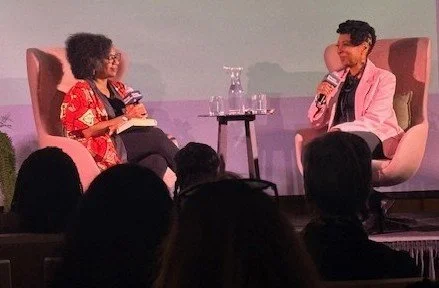
Natalie Y. Moore (left) in conversation with author Kimberle Williams Crenshaw at the recent Chicago Humanities Festival.
The necessity of claiming truth and the courage to speak out and act is what restores erased history and shapes the present and future.
Kimberle Williams Crenshaw proudly proclaims that she comes from a long line of backtalkers. These are women who refuse to not speak up against injustice and discrimination carried out by people and systems that need to change.
“The necessity of claiming truth and the courage to speak out and act is what restores erased history and shapes the present and future. @takeleadwomen #PowerUp2026”
The bestselling Black author, lawyer, feminist, activist, professor of law at the University of California and Columbia Law School, as well as co-founder and executive director of the African American Policy Forum, told a crowd recently at the Chicago Humanities Festival, that speaking and writing truth is her right, her power and her calling.
Read more in Take The Lead on race and gender equity
“Oral history is how we come to know realities before you write them down and publish them,” Crenshaw said in a conversation with Natalie Y. Moore, award-winning author, broadcast journalist at WBEZ-FM, and journalism faculty at Northwestern University.
“The personal is political for you,” Moore said in her introduction.
“I grew up with a mother telling the story of her mother being a backtalker, or a race woman who challenged segregation and the idea that she would be treated less than,” Crenshaw said.
When Crenshaw’s mother was three years old, her mother took her to the community pool in Canton, Ohio, that was segregated for white people only. Crenshaw said that her grandmother had her Black daughter enter the wading pool, and all the white children got out of the pool and the lifeguards drained out the water.
Her grandmother came back again, and again, bringing other Black children with her until finally the lifeguards stopped emptying out the water and Black children swam with the white children.
“I come from a long line of resisters,” says Crenshaw, who was one of the scholars who created the term, “critical race theory,” as well as “intersectionality” that is used all over the world in curriculum, politics, policy, culture and community but is weaponized and banned in recent attacks on DEI.
“I come from a long line of resisters,” says Kimberle Williams Crenshaw, @sandylocks @ColumbiaLaw @UCLA_law @AAPolicyForum who helped create Critical Race Theory & intersectionality, terms used all over the world in curriculum, politics, policy, culture and community.”
The term of critical race theory—often identified only by the acronym of CRT—is universally used beyond the university, academia, the workplace, and policy discussions into all arenas.
“People all over the world use it as a framework,” she said. “That helps to focus and address it.”
The terms of critical race theory—often identified only by the acronym of CRT—is universally used beyond the university and academia, in all arenas. It is also under active attack in this country.
“It is crucial now for leaders to embrace factual framing and truthful #storytelling to build legacy. Speakers and keynoters @TakeLeadwomen #PowerUp2026 share strategies of how to capture true history to change the future. ”
According to ABC News, “Since 2020, legislation on race education has popped up across the country. A total of 35 states so far have signed into law or proposed legislation banning or restricting the teaching of critical race theory, the academic discipline at the center of the debate. Critical race theory, mostly taught in universities and colleges, seeks to understand how racism has shaped U.S. laws.”
According to a 2021 report in Education Week, “The basic tenets of critical race theory, or CRT, emerged out of a framework for legal analysis in the late 1970s and early 1980s created by legal scholars Derrick Bell, Kimberlé Crenshaw, and Richard Delgado, among others.”
The relevance and urgency of what Crenshaw espouses is evident in these widespread actions to erase them. ABC reports, “Lawsuits against anti-CRT laws have already popped up in two of the states that passed them, Oklahoma and New Hampshire.”
“The pushback when people come after something, is telling you that it’s valuable,” Crenshaw said.
“The urgency of what @sandylocks espouses @chihumanities @natalieymoore is evident in widespread efforts to erase them. “The pushback when people come after something, is telling you that it’s valuable.” #CRT #DEI #truth ”
Race and gender equity in leadership is the mission of Take The Lead, and the 9 Leadership Power Tools, created by Gloria Feldt, co-founder and president of Take The Lead, maintain that assertion. The first Power Tool is, “Know your history. And you can create the future of your choice.” Power Tool No. 9 is “Tell your story. Your story is your truth; your truth is your power. Telling your story authentically helps you lead (not follow) your dreams and have an unlimited life.”
Power Up Conference 2026 will honor the 9 Leadership Power Tool Champions. Learn more here.
“Each of us is more than what we do,” Feldt said. “If we join together, we can actually be able to achieve racial and gender parity in leadership in any of our lifetimes.”
That can begin with upholding the truth.
“We need to tell the stories of our lives,” said Crenshaw, whose diligent life work is about researching, discovering and understanding her history and unredacted Black American history.
“We need to tell the stories of our lives,” says @sandylocks @chihumanities. Crenshaw is diligent about researching, discovering and understanding her history and unredacted #Black American history. ”
Read more in Take The Lead on Black women in history
The generations of Black families who moved to Ohio in the early 20th century from the South focused on building generational wealth in steel and manufacturing towns where they built businesses and bought homes.
In her new memoir, Backtalker, Crenshaw writes about her family’s stories and history of her mother as a musician and her father, a school teacher who went to law school. His goal was to assist Black families with housing that was not about “concrete ghettos.”
Read more from Gloria Feldt on race and gender equity
Her father died suddenly when she was 10. She went on to graduate from Cornell University with an undergraduate degree in 1981, then attended Harvard Law School, 1981 through 1984, where she says she experienced racism in the teachings, as well as practices, systems and processes.
“Do not give up on your dreams because of the limitations of men in your life,” Crenshaw said.
“There was a kind of racism that doesn’t announce itself,” she said. “There was precious little space for Black women. There was no hint of anti-discrimination laws because that was called preferential treatment.”
“There was a kind of racism that doesn’t announce itself. There was precious little space for Black women. There was no hint of anti-discrimination laws because that was called preferential treatment.” #sandylocks @chihumanities #history ”
Read more in Take The Lead on Black women leadership
“That became the foundation of critical race theory, to cut through the myth and the power.”
Addressing that inequity of power and not normalizing it became a motivation for her research in and after law school, as well as her journalism career and as a law professor. The use and misuse of power motivates her actions, Crenshaw said.
She wondered “what kind of remedial framework I could come up with that shows racism and sexism were not just overlapping axes of power.”
Clarification of a system or process beyond ideology makes it accessible and concretely measurable.
Knowing and naming it helps everyone to understand history as well. Crenshaw went to Washington, D.C. to assist Anita Hill in her 1991 testimony during the hearings on Clarence Thomas’ appointment to the Supreme Court of the United States.
“We knew that was going to change our lives all because they did not believe a Black woman. This moment in history has been decades in the making, It’s been abundantly clear that color blindness is the Trojan Horse racial ideology that allows us to say we are not racist,” Crenshaw said.
“This moment in history has been decades in the making, It’s been abundantly clear that color blindness is the Trojan Horse racial ideology that allows us to say we are not racist,” @sandylocks @ColumbiaLaw @UCLA_law @takeleadwomen ”
The 2025 McKinsey Women in The Workplace report shows definitively that WOC are promoted less often than white women. “The “broken rung” at the first step up to manager also continues to hold women back. This year, only 93 women were promoted to manager-level roles for every 100 men. The gap is even bigger for women of color, with 74 women of color promoted for every 100 men.”
“Broken rung @McKinsey Women in Workplace 2025 shows: 93 women were promoted to manager-level roles for every 100 men, and only 74 WOC for every 100 men. ”
“But color blindness dismantles anti-racism and enables racism. This is not news,” Crenshaw said
Crenshaw added, “All the progress of building a multi-racial society is being dismantled so it is now the same way it was in the 19th century.”
“We should talk more about race,” Crenshaw added. That means not just in the classroom, but in communities, in media, in person, in political and social circles. “This country has already been broken once, we are about to be broken again.”
A recent Gallup poll found that racism against Black people in this country is at an all-time high.
Read more in Take The Lead on workplace discrimination
“Sixty-four percent of Americans believe racism against Black people is widespread in the U.S. This figure ties with the previous reading, in 2021, as the highest recorded in Gallup’s periodic measurements since 2008. Non-Hispanic Black adults continue to be the most likely to say such racism is prevalent in the country, with 83% expressing this view. Smaller majorities of Hispanic (64%) and non-Hispanic White adults (61%) agree.”
“@Gallup: 64% Americans believe #racism against Black people is widespread in U.S. 83% non-Hispanic Black adults feel the same, the highest since 2008.”
Additionally, Gallup reports, the unfair, racist treatment against Blacks is across all settings.
“When asked if Black people in their community are treated less fairly than White people in various situations, 57% of U.S. adults say Black people are treated less fairly in dealings with the police, such as during traffic incidents. That’s far greater than the percentage who say Black people are treated unfairly when engaging in any of the other five activities measured, including when receiving healthcare (38%); when shopping at downtown stores or shopping malls (36%); while at work (34%); when in restaurants, bars or entertainment venues (32%); and when in neighborhood shops (30%).”
Listen to Gloria Feldt in conversation with Minda Harts
In the workplace, racism and the drive to eliminate it with promotions of equity and fairness are viewed differently. Pew Research shows, “About six-in-10 White adults (58%) say diversity in the workplace is important, compared with higher shares of Black (83%), Hispanic (72%) and Asian adults (74%).”
Additionally, Pew reports, “Similarly, White adults are less likely than others to say diversity efforts in workplaces and schools have made society more fair. About four-in-ten (38%) say this, compared with 53% of Black adults, 46% of Hispanic adults and 48% of Asian adults.”
In the workplace and beyond, open and transparent discussion and leadership, ideas must be welcome from all sources. Solutions are possible in openly creating fair access and equity in all processes.
“Ideas take on a life of their own,” said Crenshaw. “Intersectionality is not identity politics, it is a framework grounded in this American soil. I was trying to make sense of my own life with these frameworks to help.”
“Ideas take on a life of their own,” says @sandylocks @ColumbiaLawSchool @UofCal. “Intersectionality is not identity politics, it is a framework grounded in this American soil.” #fairness #equity ”
“I am a Black feminist. I look at race and gender and other aces of power together. We need to close the circle and allow people to integrate these differences. “
Take The Lead’s Power Up Conference 2026, Audacity: Leadership In Action features a diverse group of speakers and experts speaking on the importance of inclusive leadership and strategies to solve systemic and historical barriers. That includes an interactive panel of experts on how you can harness the power of your own voice through storytelling. Learn more and register here.
