
5 Theories and the Question No One Wants to Ask (About Babies)

Issue 2886— May 26, 2026
Novelist Jane Smiley observed that pregnancy is the most public of private conditions.
Smiley captures the paradox of the maternal experience. While the physical, emotional, and psychological journey of gestation is intensely intimate and internal, a pregnant woman's body inherently becomes the subject of public observation, societal commentary, workplace policy, and political debate.
Today, that public condition is more often observed about women who are not pregnant or child rearing.
Without fail, discussions about whether there are too many or not enough babies coming into the world point the finger at women.
During the 1960’s through the 90’s, alarmists declared high birth rates were going to be the ruin of the earth, and we had to stop those women. (Anyone remember Paul Ehrlich’s The Population Bomb?)
Now, “Why are women having fewer babies?” is the question.
The Financial Times sounds that alarm, referenced by longevity and leadership strategist Aviva Wittenberg Cox in her LinkedIn post on the topic, with these statistics: “In more than two-thirds of the world’s 195 countries, the average number of children born to each woman has fallen below the “replacement rate” of 2.1 that keeps populations stable without immigration. In 66 countries, the average is now closer to one than to two. In some, the most common number of children born to each woman is zero.”
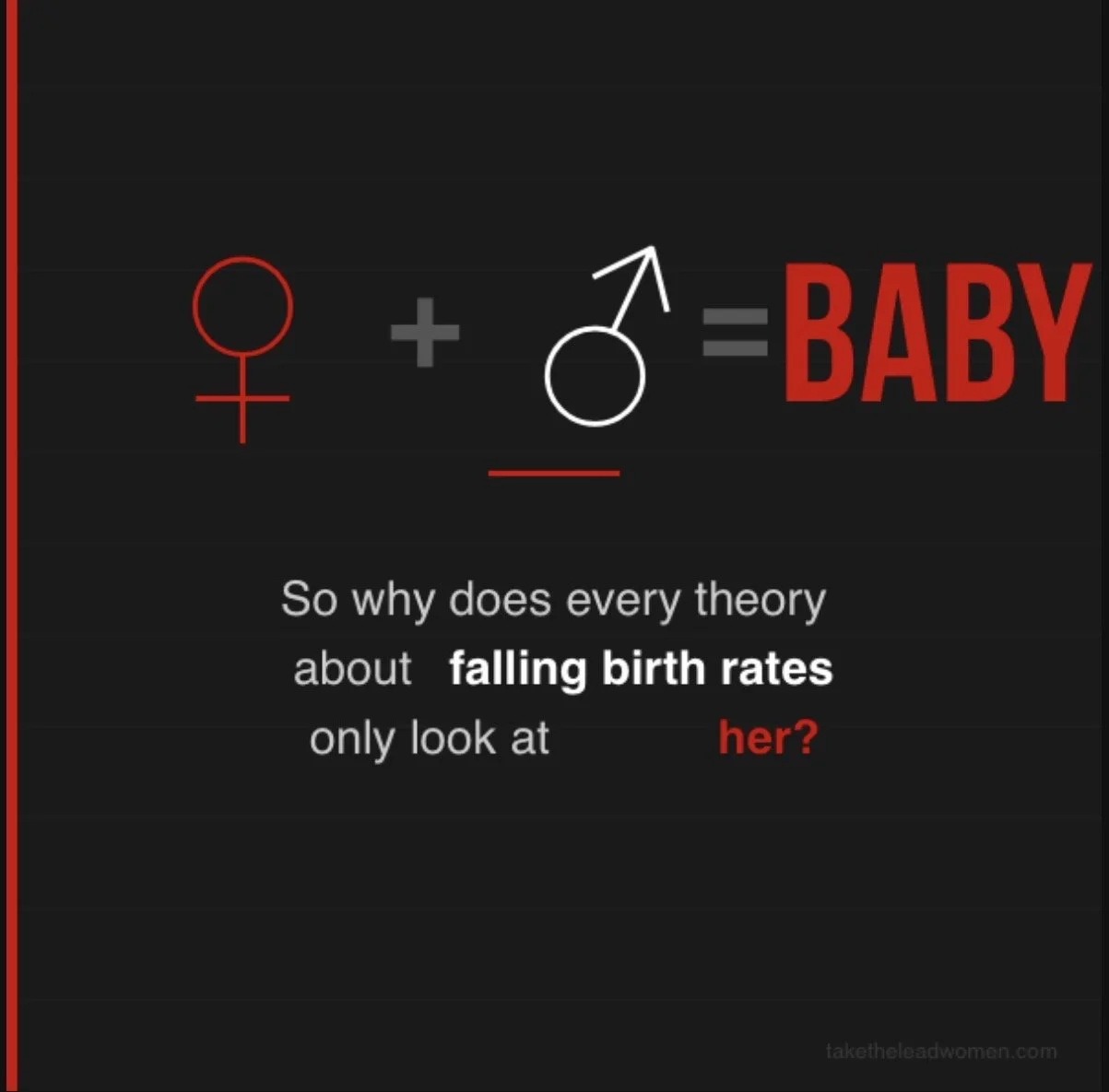
Wait. Does it not still take two to make a baby, or did I miss the news that cloning has become the technology of choice for procreation?
And does the family unit, regardless of the partners’ gender, not exist within a larger culture, social discourse, policies that govern laws, and workplace practices?
So I took a deep look into the various theories of why the birthrate is falling globally. They organize themselves into these five buckets:
Women are too educated. Economic costs of raising children are too high. Women have more freedom and are using it. Cultural behaviors shift in response to changing technologies. Structural failures are the problem.
Let’s look at each of these theories.
1. Women are too educated. This is based on older studies that found an inverse correlation between higher educational level and lower numbers of children. More recent findings, such as this analysis by the Institute for Family Studies suggest that as education levels for women have risen globally, strained economic conditions more prevalent in women with lower education levels are now as strong a correlation.
2. It’s hard to argue with the reality that the cost of raising children is too high, especially in the U.S.. Children are expensive. Housing costs, childcare costs, college costs — the math doesn’t pencil out for young adults already buried in student debt and priced out of housing. Rational people make rational choices.
The Great Recession left a scar. Post-pandemic inflation deepened it. When gas prices are soaring and shelter itself is a luxury, a baby is a non-starter.
To me, that’s being responsible adults, not a negative aspersion on women.
3. Women have more freedom and are using it. Not that there’s anything wrong with that, to riff off of Jerry Seinfeld, as my eyes roll.
This one is hardly worth taking it seriously, but let me try. Tumbling fertility rates are, in many ways, a success story, reflecting better and more available contraception enabling women to choose when, whether, and with whom to have children.
This in turn creates more opportunities for education and employment. Maternal and infant death rates have plummeted in the last century because of it. The decline in teen birth rates alone represents one of the greatest public health achievements of the last 30 years.
4. Cultural behaviors shift in response to changing technologies. The Vatican newsletter once mused that washing machines giving women more spare time were the cause of the women’s liberation movement. Wittenberg Cox’s more thought-provoking post attributes lower birthrates to the cell phone and resulting isolation when we have our eyes on the technology instead of each other. This, she says, is a social design problem that needs to be addressed.
Technology undoubtedly pays a role. For example, reliable birth control is a technological advance that changed women's life options profoundly, and with that changed family structures. But once having made that change, it became necessary to change society's ideas about marriage, family, and responsibility for children as well. We are clearly not there yet. It's a design problem to be sure, but there is something deeper at work. Because humans are not marionettes whose moves depend entirely on the strings of design being pulled.
5. Structural failures are perhaps the easiest to identify and most challenging to fix, because they require policy changes.
As someone who worked in the reproductve health world for 30 years and the advancement of women for half a century overall, I’ve seen that we have been more successful changing the legal structures for women than changing the traditional biased structures within which women, men, and systems operate.
Workplace flexibility. Career advancement that isn’t compromised by taking time off for caregiving. Affordable, quality childcare. Family leave without stigma for men as well as women. Pay equity and a living wage that makes children more affordable. All these would remove many structural barriers to childbearing.
As Moms First founder Reshma Saujani’s new film, “No Country for Mothers” illustrates, if our structures didn’t make it so hard to be moms, more of us might use our freedom to have more children.
Here is what you will notice about every one of the five theories.
They are all about women.
Women are too educated. Women are too free. Women’s values have changed. Women find children unaffordable. Women face structural barriers.
Why?
Because fertility has always been treated as women’s work.
The “total fertility rate” is literally measured by counting births per woman. Men’s reproductive choices, behaviors, and responsibilities are not systematically tracked the same way.
When demographers talk about fertility, they mean female fertility. When governments panic about birth rates, they design incentives aimed at women’s bodies and women’s choices. When experts construct theories about birthrates, they reach first for what women are doing or not.
This is not biology. Biology says sperm are required. This is ideology — the ideology that reproduction is fundamentally a female responsibility and a female problem.
What would happen if we asked different questions? For example:
- Why are men, particularly young men in wealthy countries, increasingly disengaged from serious partnership and co-parenting?
- What is the effect of the growing share of men who have fathered zero children — a trend that has grown faster than women’s childlessness in some countries?
- If the structural theory is correct — that inflexible workplaces make parenthood too costly — why is the solution always aimed at enabling *women* to manage that burden better, rather than requiring *men* to share it equally?
- When we talk about cultural shifts, why do we assume cultural values belong primarily to women making reproductive choices, rather than to men who are equally less interested in commitment, sacrifice, and the long responsibility of raising another human?
The birth rate is not falling because women are failing.
It’s falling because the systems, structures, and social expectations built around reproduction have not adapted to a world where women have options.
And because men’s role in the equation is too often missing from the conversation. Women have gained reproductive power. But power unused is power useless
The question worth asking is why, the moment women use their power, the whole world treats it as a crisis — and why the answer is always to look at *her.*

These are the shoes Amelia Pittner wore to Take The Lead’s audacious event on 5/20.
The 50 Women Can Lead the Change Valley of the Sun Chapter has officially launched.with
a program entitled “Becoming Her” that featured Catherine Alonzo sharing her new
book The Changemaker’s Toolkit.” Amelia attended the Power Up Conference
last year and now she is a founding member of the new chapter! Come meet her in
D.C. August 26.
PS: If these five theories are important to you, I’m excited to give you a sneak preview of two panels that will address them at Take The Lead’s Power Up Conference August 26 (Women’s Equality Day, natch!) in Washington, D.C..
1. In a panel tentatively titled “ The Power of Care: Women Leading at Work and at Home,” leaders, advocates, caregivers, and workplace experts will share practical strategies for navigating the emotional, financial, and professional realities of caregiving, from raising children to supporting aging parents and loved ones. We’ll share ways to set boundaries, negotiate flexibility, advocate for workplace support, and build more sustainable career paths. Panelists will offer tools for managing burnout, redefining success, strengthening support systems, and creating workplace cultures that value both leadership and caregiving. Attendees will leave with practical insights, renewed confidence, and strategies to lead with greater clarity, balance, and audacity in every aspect of life.
2. In “Sex and Leadership: Advocacy, Access & Answers, we’ll tackle Jane Smiley’s paradoxical observation. Women have long been judged, underestimated, objectified, or penalized because of perceptions tied to appearance, confidence, sexuality, and femininity, often forcing them to navigate impossible double standards around ambition, likability, authority, and authenticity. At the same time, women also possess immense personal power, presence, influence, and emotional intelligence that can be harnessed as strengths in leadership. Panelists will explore the lasting impact of sexual harassment, toxic workplace cultures, and gendered expectations that have prevented many women from advancing, feeling safe, or remaining in certain leadership pipelines. The takeaways will include how women can establish boundaries, lead authentically, navigate perceptions strategically, and claim agency over how they show up professionally without diminishing their identity or power.
I will be THRILLED to see you there to create solutions to these important challenges together. Register here for tickets or to help us by sponsoring. Feel free to message me @gloriafeldt on LinkedIn or Instagram if you have questions.
GLORIA FELDT is the Co-founder and President of Take The Lead, a motivational speaker, and a global expert in women’s leadership development and DEI for individuals and companies that want to build gender balance. She is a bestselling author of five books, most recently Intentioning: Sex, Power, Pandemics, and How Women Will Take The Lead for (Everyone’s) Good. Honored as Forbes 50 Over 50, and Former President of Planned Parenthood Federation of America, she is a frequent media commentator. Learn more at www.gloriafeldt.com and www.taketheleadwomen.com. Find her @GloriaFeldt on all social media.