
Advice on History-Making Success From 10 Women World Leaders Today
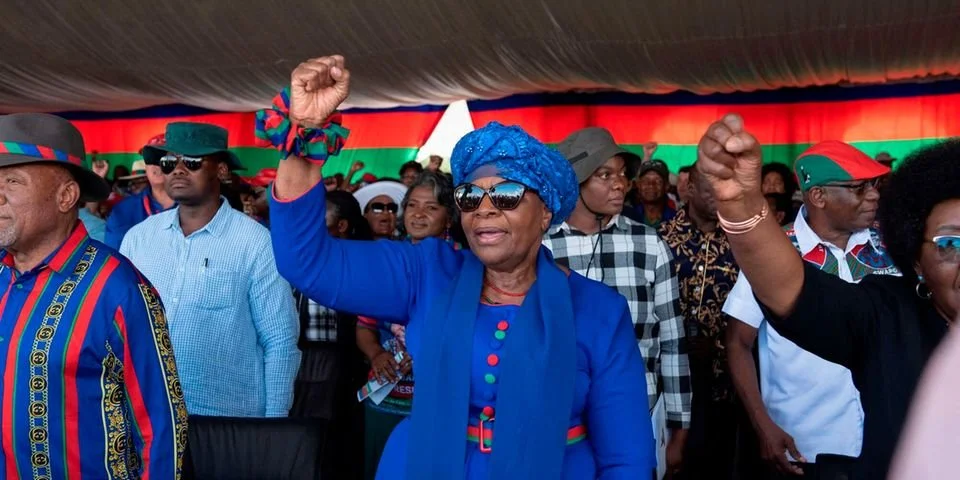
Netumbo Nandi-Ndaitwah (center) is the first female president in Namimbia history.
With International Women’s Day celebrated on March 10, 115 years after its founding, it is the perfect time to acknowledge that the women at the very top of world leadership today are living role models for how each one of us can make history daily.
And we can also acknowledge that women have been making history for longer than a century. And that you make history with your lives every moment.
Learning and knowing how to make your efforts matter in the bigger picture is worth your time, particularly during Women’s History Month, when the country and the world salute women whose efforts have produced changes. Even if the end goal is not fully achieved. Yet.
With the theme of “Give To Gain,” this year’s IWD is suitable for paying close attention to what paths and strategies women leaders at the very top of their country’s political systems are making around the world to initiate and preserve improvements in today’s culture. There is so much to take in from women across the globe who are changing their country’s history each day.
“#InternationalWomensDay theme #GiveToGain is perfect for witnessing strategies top political women leaders are making around the world to initiate #gender #fairness. @takeleadwomen”
“Making systemic change, getting the whole patriarchal culture unstuck, is how we create a new and brighter future for everyone, including men who have been as boxed in by the expectations of masculinity as women have been limited by gendered social expectations, overt discrimination, and implicit bias,” writes Gloria Feldt, Take The Lead co-founder and president, in honoring Women’s History Month.
“Making systemic change, getting the whole patriarchal culture unstuck, is how we create a new and brighter future for everyone,” says Gloria Feldt, co-founder, pres @takeleadwomen. #InternationalWomensDay”
According to the UN, “In 193 Member States of the United Nations, 21% of Prime Ministers and 26% of Parliamentarians are women. Female leaders also make up 34% of local government positions.”
That is not reaching the gender equity goal, but it is gaining momentum. These women leaders of countries (listed in alphabetical order by last name) have different heritages, backgrounds, expertise, identities and missions, but their insights can be helpful and inspiring. Each of them is a pioneer, many of them acting as the first woman in their coountry’s role in history.
“In 193 Member States of @UN, 21% of Prime Ministers, 26% of Parliamentarians are women, 34% of local government positions. #InternationalWomensDay #WomensHistoryMonth”
Read more in Take The Lead on Women’s History Month.
1. Catherine Connolly, President of Ireland. “Many of the solutions to the challenges we face must be delivered locally. Meaningful action is needed at every level of society and economy as climate change affects every sphere of our lives,.” Connolly said. Winning the election by a landslide with 63% of the vote, she is considered left-leaning and said on election night, “Our public and democracy need constructive questioning. Together, we can shape a new republic that values everybody, that values and champions diversity and that takes confidence in our own identity.”
2. Mette Frederiksen, Prime Minister of Denmark. Pushed into high stakes negotiations recently as the U.S. claims it will take control of Greenland, Frederiksen is practicing calm and firm diplomacy. A new Center for Public Affairs Research survey conducted in February shows “seven in 10 U.S. adults disapprove of how the U.S. is handling the Greenland issue.” Frederiksen said this in an interview: ”I was born in 1977. My political awakening began with Nelson Mandela and his fight for freedom. At the age of 12, I was a member of the African National Congress (ANC) youth group that supported him. Looking back, the three-and-a-half decades since the fall of the Berlin Wall were almost a golden era – despite the wars in Yugoslavia, terrorism, and all the other crises. That era is over. We are at the beginning of a new age, one that is more uncertain and, therefore, more dangerous.”
“We are at the beginning of a new age, one that is more uncertain and, therefore, more dangerous.” @MetteFrederiksen, Prime Minister @Denmark #WomensHistoryMonth”
Read more in Take The Lead on women in U.S. politics
3. Katrín Jakobsdóttir, Prime Minister of Iceland and chair of the UN Council of Women World Leaders. In 2023, Jakobsdottir led a national strike by more than 100,000 women and non-binary individuals for gender equity. “My dream is that we will do that [achieve full gender equality] before 2030, but I know it will take a lot of effort. We have been making changes in legislation when it comes to both of these issues and hopefully we will see us continue to move forward.” She added: “This is just not acceptable that women around the globe will have to wait for full equality for 300 years.”
4. Giorgia Meloni, Prime Minister of Italy. In the world spotlight as the 2026 Winter Olympic Games were held in Italy, she also faced protests of thousands of Italians who were against hosting the Olympics due to rising costs. She is straightforward in her response. “Then there are those who are enemies of Italy and Italians, demonstrating ‘against the Olympics’ and ensuring that these images are broadcast on television screens around the world.” She is seen as a calm, neutral influence with EU nations as well as with the U.S., and said on a recent visit to the White House, “I'm proud of sitting here as prime minister of an Italy that today, has a very good situation despite the difficulties, a stable country, a reliable country, one million more jobs in the last two years and half.”
Read about first Taiwan female president in Take The Lead
5. Samantha Mostyn, Governor General of Australia. Successful businesswoman and gender equality advocate, she was chair of the federal government’s Women’s Economic Equality Taskforce before becoming only the second woman GG in Australian history. Her efforts after the terrorist attacks in Bondi Beach and her views about the critical importance to honor the legacies and contributions of 65,000 years of First Nations people receive accolades. She says when she was elected her then 24-year-old daughter told her, “You can only take this job if it will make you happy.” Mostyn says, “I think in order to do this job well, it must be more than service and duty.” She adds, ”There is such good in this country.”
“I think in order to do this job well, it must be more than service and duty,” says Samantha Mostyn, Governor General @Australia #womenleaders #global #IWD ”
Read more in Take The Lead on women leaders globally
6. Droupadi Murmu, President of India. With a current population of 1.4 billion, India is on track to be the most populated nation in the world. Key to her mission is “a powerful narrative of gender justice, inclusion and human dignity.” At the recent Black Swan Summit India, Murmu said, “India’s fintech journey should be remembered not merely as a story of technological advancement, but as the backbone of India’s financial inclusion drive, with over 56 per cent of Jan Dhan accounts held by women. Every new fintech platform, product and policy must be assessed on whether it enables women’s active participation in the digital and financial ecosystem. An inclusive fintech system is where women are visible at every level, from village-level entrepreneurs and banking correspondents to engineers, startup founders and board members.”
“An inclusive fintech system is where women are visible at every level, from village-level entrepreneurs and banking correspondents to engineers, startup founders and board members,”says Droupadi Murmu, President @India #IWD #leaders ”
Read more in Take The Lead on women running for office
7. Netumbo Nandi-Ndaitwah, President of Namimbia.The first female president of the country since its formation of independence in 1990, Nandi-Ndaitwah announced recently that starting this year “all public university and vocational education in Namimbia will be free of charge. This historic move makes Namimbia one of the few African nations to offer fully subsidized tertiary education and signals a strong commitment to empowering youth, reducing inequality, and investing in long term national development.” She also in 2025 announced that she will oversee the Ministry of Industry, Mines and Energy that “oversees Namibia’s diamonds, uranium, copper and its nascent oil & gas ambitions — all of which are critical to the country’s economic diversification and export future. By assuming direct control, the president sends a signal: the extractive sector is now a top‐priority part of the national agenda.” Upon her election, she said, “The task facing me, as the fifth president of the Republic of Namibia, is to preserve the gains of our independence on all fronts and to ensure that the unfinished agenda of economic and social advancement of our people is carried forward with vigor and determination to bring about shared, balanced prosperity for all.”
Read more in Take The Lead on women in government
8. Claudia Sheinbaum, President of Mexico. The country’s first woman and first Jewish president, in office since 2024 is undergoing extreme global scrutiny in the violent chaos, disruptions in tourism and safety after the Mexican army killed Nemesio Ruben Oseguera Cervantes, known as “El Mencho,” head of the drug cartel. The cartel responded with violence across many cities, and security forces are regaining control. Intending to rid the country’s leadership of compromised politicians. Sheinbaum is also facing tariff threats from the U.S.. An accomplished energy and climate change scientist, she is a member of the National Regeneration Movement. In her acceptance speech after election, she said, “I didn’t make it alone. We’ve all made it, with our heroines who gave us our homeland, with our mothers, our daughters and our granddaughters. It’s time for women. We will continue to build together a more just and prosperous future for our people.”
“Mexico Pres. @ClaudiaSheinbaum: “I didn’t make it alone. We’ve all made it, with our heroines who gave us our homeland, with our mothers, our daughters and our granddaughters. It’s time for women.” #IWD #WomensHistoryMonth #leadership”
9. Julie Sweet, Chair & CEO, Accenture, U.S.-based. To avoid partisan politics, Take The Lead salutes listed someone U.S.-based in economic and business leadership, not political. Listed recently as one of the most powerful women in the world by Forbes, she spoke at the World Economic Forum about tech and AI. “The future of AI and companies is human in the lead.” Having introduced robotic process automation “around 2015,” she told Axios, leaders had “more technology that they’re managing and fewer humans.” She said, “Companies are led by humans and they will win by tapping into human creativity.”
“Julie Sweet, Chair, CEO @Accenture: “The future of #AI and companies is human in the lead. Companies are led by humans and they will win by tapping into human creativity.” #womensleadership #IWD #WomensHistoryMonth”
Read more in Take The Lead on US Ambassador
10. Sanae Takaichi, Japan's first-ever female prime minister, who is highly conservative and leads the Liberal Democratic Party, was recently re-elected in a landslide. While she has traditional views on cultural roles, she expresses a need for gender equity, saying, "Empowering women is essential for Japan's growth and prosperity." She added, "We must create a society where women can shine in every field." Takaichi, who worked in the U.S. under Democratic Sen. Pat Schroeder of Colorado in the 1980s, has pushed for more funding for women’s health and has been open about personal infertility and menopause issues. "Gender equality is not just a women's issue; it benefits everyone," she said. "We need to break down barriers that prevent women from succeeding."
