
Shecession or SheChange: Why Are Women Leaving Workplaces?
Issue 2876— February 23, 2026
Have you heard the saying that there are lies, damn lies, and statistics? One harmful statistic making the rounds is that women are leaving the workforce in droves.
That story is incomplete at best and misleading at worst. Hundreds of thousands of women have been pushed out of their jobs involuntarily. Other women have indeed chosen to leave the workplace that wasn’t working for them, but most of those haven’t stopped working.
Let’s look at the actual data.
According to a study by Catalyst, almost 500,000 women lost or left jobs from January through August, 2025. Disproportionally, almost 300,000 Black women were displaced from their positions by political cuts, particularly in government, other public service, and care focused fields.
That is a serious problem for individuals and for the economy as a whole. When those losses happen, the impact doesn’t stop with a woman who is displaced from her job. It flows through families, caregiving arrangements, and entire communities.
And it affects even those who are still in their jobs.
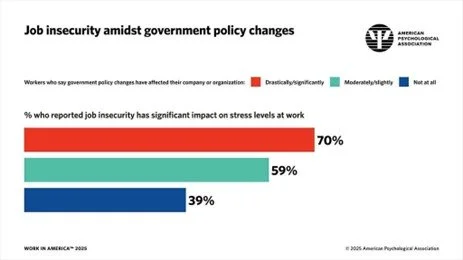
The 2025 APA study shows that 70% of workers who don’t feel safe in their job experience high stress levels at work — women and men included.
This displacement and insecurity are why Take The Lead is offering scholarships, thanks to some generous donors, to its signature 9 Leadership Power Tools online course for women who have been displaced from their positions. If that describes you, please apply. We truly want to help.
It is simply wrong to say women are leaving the workforce without explaining the circumstances.
It is true that some women are choosing to leave workplaces that don’t work for them. That’s a privilege many don’t have.
But whether leaving voluntarily or being pushed out, there is a distinct trend: women aren’t willing to put up with the status quo workplace. They are prepared to risk to find better options.
Regardless of why women are exiting the workforce, calling this a “shecession” or saying women are “leaving work” moves responsibility away from leaders and systemic barriers and unfairly places the onus on women themselves.
We are by and large done with that.
That’s why I say it’s not a Shecession. Instead, it’s a “SheChange.”
Because that’s what’s really going on even though no one is reporting it that way.
If this disrupts things for a while, so be it.
It’s 2026. Women are taking a stand. Not by leaving paid work. But by leaving workplaces that don’t serve them. A recent McKinsey/LeanIn report was even called out in Forbes downplaying the critical point that “corporations are making deliberate choices that harm women's advancement.” Nor is it accurate to say, as the study surmised, that women have less ambition than men. That is pure BS, as I wrote previously.
As the Forbes article notes:
What would you expect women to do in response?
I’ve learned from leading through many disruptions that disruption can force better solutions to emerge. I’ve done this inside institutions of various sizes and missions. Teaching in Head Start classrooms, leading Planned Parenthood through some of its most volatile years, and starting Take The Lead to accelerate women into their fair share of leadership positions.
Is This Moment Reshaping Women’s Relationship to Work?
I hope so. Also, I hope work is reshaping its relationship to women.
Economic instability, caregiving demands, and organizational inflexibility are converging. When pressure compounds across systems, women can adapt how and where they work–-or they can change both.
For example, women carry the majority of the mental and physical work of caregiving, and they’re tired of it. So it’s not surprising that when they can, they leave workplaces that no longer recognize their value, support their lives, or adapt to reality.
Sometimes women take a step back (or away) to prioritize their children and de-prioritize themselves and their ambition. Or they run on an empty tank trying to be everything to everyone.
Reshma Saujani, Founder and CEO of Moms First, says it best: “No one is coming to save moms.”
But that doesn’t mean mothers are falling short. Our system is. When ‘taking care of the kids’ is treated like a ‘mom problem’ not a shared responsibility issue, women are usually the ones who get hit with the financial, emotional and professional load.
That’s the systemic situation that must change.
What If in the SheChange, Women Aren’t Stopping Work - But Shifting to Work in Institutions They Believe Deserve Their Energy?
Women always have been, always will be ambitious. And now women are being more selective about which institutions are worth our energy, integrity, and nervous systems.
This moment is not about workforce participation or productivity. It is about power. About who designs work. Who absorbs instability. And who is expected to stay quiet and grateful while the ground keeps shifting beneath them.
When systems do not protect your dignity, leaving is not failure. It is leadership. And leadership does not require constant chaos or burnout. Leadership requires steadiness and intention.
Like Olympic 2026 gold medalist skater Alysa Liu’s example. She quit competing because the system and other people’s expectations were crushing her spirit. She refocused, centered herself, and returned to win gold this year with the most joyous performance that captivated audiences globally. She’s my role model and the woman I aspire to enable---to know herself, embrace her power, and embody her own highest intentions.

Alysa Liu, gold medal figure skater on the USA women’s team at the 2026 Winter Olympics.
If women were truly opting out, we would see them disengaging from economic activity altogether. That’s not happening. Most are still working, still contributing, and still leading -- but not always inside traditional corporate structures.
Increasingly, women are choosing project-based work, consulting, and entrepreneurship. Michele Weldon’s post on Take The Lead’s Movement Blog illustrates a variety of side gigs many women have in this uncertain economy.
Take the trend toward entrepreneurship. Women are starting their own businesses in record numbers. In 2024, female entrepreneurs started 49% of all new businesses -- a 69% increase from 2019, and the highest rate in the past five years.
What Makes a Workplace Worth Women’s Energy Today?
A workplace is worth women’s energy today when it offers flexibility, trust, and respect for caregiving realities while allowing ambition to flourish.
And if talented women are building alternatives, either because they have been displaced or because they are over waiting for systems to change, what does that say about how institutions are going to have to change?
I’d love to hear what you’re seeing and thinking. Leave your thoughts in the comments below 👇
🔴 ICYMI: Download the 4 Power Principles to Own in 2026
In conversations lately, I’m struck by how many women are in some kind of transition. Leaving work that no longer feels authentic. Building something new. Standing in that in-between, liminal space where the destination feels clearer than the path.
It takes courage to stay there long enough to choose what’s next. But the good news is that there is opportunity in this crisis to choose a future that is consistent with your values and needs.
I’m sharing a short PDF below that may help you reflect on your next steps - small ones or giant leaps. Consider it a companion for this moment.
👉 Download it here
GLORIA FELDT is the Co-founder and President of Take The Lead, a motivational speaker, and a global expert in women’s leadership development and DEI for individuals and companies that want to build gender balance. She is a bestselling author of five books, most recently Intentioning: Sex, Power, Pandemics, and How Women Will Take The Lead for (Everyone’s) Good. Honored as Forbes 50 Over 50, and Former President of Planned Parenthood Federation of America, she is a frequent media commentator. Learn more at www.gloriafeldt.com and www.taketheleadwomen.com. Find her @GloriaFeldt on all social media.