
Emma Grede Is Saying It Out Loud; And I’m Loving It
Issue 2883— April 28, 2026
Full disclosure: I'm still listening to Emma Grede’s new and already bestselling book, Start With Yourself. Haven't finished it. But I've heard enough — and watched the Internet melt down enough — to start the conversation now. More posts will follow.
Emma Grede grew up poor in East London, dropped out of school at 15, is openly dyslexic, and built a $400 million empire starting with unpaid internships (which she thinks there should be more of) and sheer will, for which she thanks the challenges of her early life.
Co-founder of SKIMS. CEO of Good American. First Black woman investor on Shark Tank. Though some are pointing out the privileges she has had along the way (such as a successful white businessman husband with connections), she has the slightly rough and tough edge of someone who didn’t come from privilege and wants others to know you can start from wherever you are—as long as you start by knowing and valuing yourself.
Though I grew up in West Texas rather than East London, there are some similarities (I too left high school at 15 for different reasons but that’s a whole ‘nuther story.)
Now Emma has a book. And she has staked out a clear position – not shrinking from strong stands about what she believes from her lived experience.
I like that about her.
I teach leaders to embrace controversy — not to manufacture drama for its own sake, but also not to soften a genuine position just because it makes people uncomfortable.
There are two kinds of controversy: the kind you make because you want to start a fight worth having, and the kind you take because it comes to you. Grede has both going on. Good. It makes people pay attention. I suspect that’s exactly why she does it. Here are a few examples:
“Don’t wait for confidence.”
People keep asking her how she got so confident. Her answer: she didn't get confident. She earned it.
You might have heard me say confidence is overrated. You don't wait for it to show up before you act. You grow it like a muscle — by doing the thing before you feel ready. Emma’s success trajectory is the proof of that principle.
"Work from home is career suicide."
Her argument is blunt: visibility drives promotions, pay, and access. Remote work, she says, is quietly costing women the career ground they think they're protecting. Critics — especially Black women — are pushing back hard: visibility doesn't save women who were never going to be seen in the first place. Neither is the class argument: her advice hits differently when you can't afford the commute or the childcare that makes showing up possible.
So is she wrong? Or is she right about a game that was never designed to be fair — and we just hate hearing it?
"I'm a max three-hour mum."
She often says three hours at a time with her kids is enough to give them the parenting they need from her— and she’s upfront that her setup includes nannies, a chef, cleaners, and a chief of staff. Critics say she's describing a lifestyle most of us can’t even imagine having, not realistic advice. Maybe. But she's also doing something rare: a powerful woman saying out loud that she doesn't orbit her children's every need, and she's not apologizing. How many women think this and say nothing because the judgment isn't worth it?
"Work-life balance is your problem, not your employer's."
This is where she gets Lean In comparisons — and not as a compliment. The sharpest critique: this is advice for a world where structural barriers have already been removed. No book about individual mindset closes a support deficit. And yet — what do you do while you wait for the system to change? Waiting has its own cost. As Blessing Adesiyan wrote on Substack:
“Women are not the problem. The unequal distribution of care is. And no book about individual ambition will fix a structural crisis. The most radical thing we can do for women right now is hand the next self-help book to a man.” - Blessing Adesiyan, The Care Gap
The real question she's asking.
I distinguish between ambition and intention. Ambition is I wish, I want, I hope. Intention is I will. I am. I already see it. I created the word #intentioning — turning intention into an active verb — because the distinction matters enough to name it.
Emma Grede doesn't just talk about what she wants. She moves. She decides. She's been #intentioning since long before anyone had a word for it.
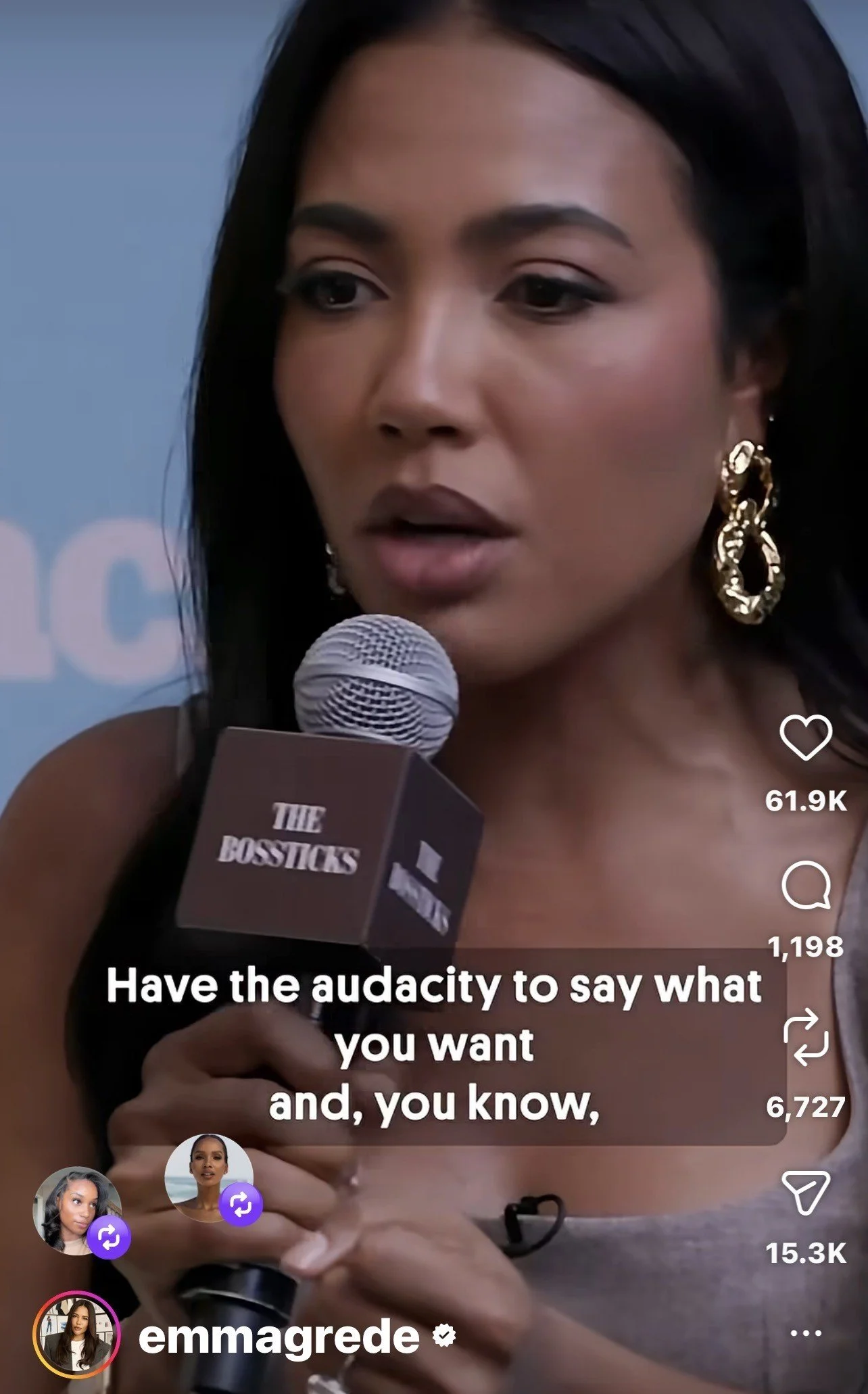
Her book is not a policy paper. It's a mindset — and a provocation. It's asking you one uncomfortable question: Are you a passenger in your own life, or are you driving?
More posts are coming when I finish the book.
Meanwhile, two things:
First, I’d love to know where you come down on Emma’s points of view. Comment below ⬇️ and let’s discuss.
Second, join me for Take The Lead’s Power Up Concert and Conference in Washington DC August 25 and 26. Grab your ticket here while early bird pricing is on through April 30. In addition to seing Margaret Atwood, iconic author of The Handmaid’s Tale and The Testaments, you’ll be part of a vibrant discussion of how we solve the problems that hold women back.
GLORIA FELDT is the Co-founder and President of Take The Lead, a motivational speaker, and a global expert in women’s leadership development and DEI for individuals and companies that want to build gender balance. She is a bestselling author of five books, most recently Intentioning: Sex, Power, Pandemics, and How Women Will Take The Lead for (Everyone’s) Good. Honored as Forbes 50 Over 50, and Former President of Planned Parenthood Federation of America, she is a frequent media commentator. Learn more at www.gloriafeldt.com and www.taketheleadwomen.com. Find her @GloriaFeldt on all social media.