
Go Red: What "The Handmaid's Tale" Gets Right About Power
Issue 2881— April 13, 2026
We were speeding along from Arizona to Michigan in my husband’s red Ferrari in the summer of 1986.
He got four tickets. I was reading Margaret Atwood’s all-too-prescient book, The Handmaid’s Tale and trying not to notice the speedometer.
Ironically, 1986, the year The Handmaid’s Tale was published in the US portending the stripping away of women’s rights, was the start of the three-year celebration of the 200th anniversary of the United States Constitution.
“It was never about piety. It was always about power.”
That line stayed with me after watching the televised version’s last season of the iconic book.
“It was never about piety. It was always about power.”
It emphasized that Gilead, the book’s fictional setting, didn’t happen overnight.
And it didn’t start with red robes and rituals.
It started with fear.
Fear and people who knew how to use it to take power over a population yearning for a certain kind of order.
Fertility was declining. People felt something slipping. There was this sense that things were falling apart, and no one knew how to fix it.
So when someone came along with answers—clear, structured, certain—people listened.
A whole system was presented as the solution—wrapped in religion, tradition, and language that sounded protective, even reassuring.
At first, nothing looked extreme. Each step made sense on its own.
Temporary. Necessary. For the greater good. No single moment felt like the breaking point.
June, once a handmaid, doesn’t see it right away either.
By the time she does, it’s too late.
But what stays with me is this: The women in Gilead were never actually powerless.
They were controlled. Silenced. Stripped of rights.
But not powerless.
They saw things.
They understood more than they were supposed to.
They noticed where the rules didn’t quite add up to the solutions they promised.
And slowly, they started to use that awareness.
Not in big, dramatic ways.
A look.
A hesitation.
A decision not to comply.
Small things.
Until they weren’t small anymore.
Because systems like Gilead don’t run on written rules or Constitutions alone.
They run on something closer to complicity than we like to admit.
That part feels familiar.
Not because we live in a place called Gilead. But because we know what it’s like to adjust. To make things work. To try to live our lives despite the gradual erosion of freedoms.
We call it being practical. Realistic.
And sometimes it is. Because what can one person do?
We get very good at navigating systems. Less comfortable questioning them. Terrified at challenging them.
But over time, it becomes something else. And the breaking point eventually comes.
What The Handmaid’s Tale shows—slowly, painfully—is what happens when women stop adjusting to the system and start pushing back.
They weren’t handed power. They started using what was already there, what they had. And they broke the boundaries of complicity when the consequences became sharply personal.
June didn’t start fighting Gilead because she wanted power.
She did it because of Hannah—her daughter.
And it wasn’t only June.
Serena, one of the women who helped build Gilead, believed in it. She enforced it.
Until she had her son.
And suddenly, the same system she once defended became something she couldn’t live with.
That’s a mother’s love. And that’s the kind of power we don’t talk about enough.
The person whose fertile mind and pen imagined Gilead understood that from the start. So she told the story that has now captivated generations.
It’s why hearing directly from Margaret Atwood—the mind behind that world—feels eerily timely right now.
Perhaps you’re watching the sequel to The Handmaid’s Tale, The Testaments, now showing on Hulu. This new series has put the dystopian tale back at the top of our minds.
Can it happen here? Is it already happening? And if so, what do we do about it?
Atwood will be speaking at Take The Lead’s upcoming Power Up Conference in Washington DC on Women’s Equality Day, August 26, 2026, where there’s space not just to listen, but to ask questions and push the conversation further.
I’m excited to interview her in a fireside chat. And if you’re there, you’ll have a chance to ask her questions.
If you’re curious, you can learn more and register here: www.thepowerupconference.com
I hope you’ll join me for that and stay for the rest of the day when we will shape solutions together.
Because that’s exactly the conversation we need to be having now.
And you’re welcome to wear red. Most likely I will.
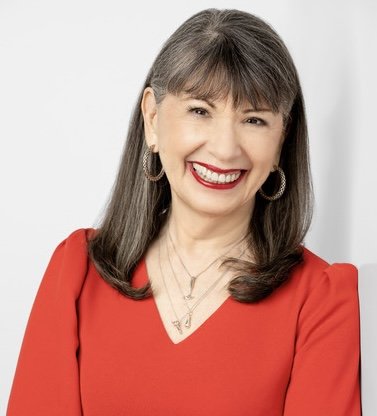
GLORIA FELDT is the Co-founder and President of Take The Lead, a motivational speaker, and a global expert in women’s leadership development and DEI for individuals and companies that want to build gender balance. She is a bestselling author of five books, most recently Intentioning: Sex, Power, Pandemics, and How Women Will Take The Lead for (Everyone’s) Good. Honored as Forbes 50 Over 50, and Former President of Planned Parenthood Federation of America, she is a frequent media commentator. Learn more at www.gloriafeldt.com and www.taketheleadwomen.com. Find her @GloriaFeldt on all social media.