
Redeeming Hedy: How Women Can Lead in Technology and Why This Is the Moment to Shine

Issue 2878— March 17, 2026
The energy in the room was palpable, even after the previous evening’s taco and tequila night, and I was pumped for my keynote. Three hundred ambitious women (yes, McKinsey, women are very ambitious) spanning a wide range of roles in technology, and a few male allies, met in San Diego March 10-12 at the WIT (Women in Technology) Network annual conference.
The theme, “Igniting Excellence: Rising Together, Leading Forward,” exudes the event’s upbeat ambiance. Congratulations to the organizers and especially to WIT Network’s CEO Christine Bongard and her team.
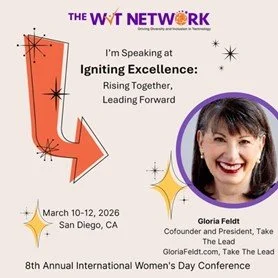
I opened my speech with the question, “How’s your Wi-Fi working today?” There were quizzical looks, like what in the world is this woman talking about?
Well, it was Women’s History Month after all, and I was there to inspire the brilliant women in technology to claim their power, own their leadership intentions and insist on getting the recognition they deserve for their contributions.
So I had to start with a little history, and am sharing the speech with you.
“Who knew, before you saw the description of this speech, who invented the technology
that made Wi-Fi and many of your jobs possible,” I asked, and answered:
Yes, Hedy Lamarr.
She invented technology that became the foundation for Wi-Fi, Bluetooth, and GPS. During World War II, she invented a “Secret Communication System,” together with avant-garde composer George Antheil. The system used the concept of frequency hopping to guide torpedoes in a way that was un-jammable.
The U.S. military ignored the potential for 20 years. Twenty years later, the technology was used for military communications.
Her patent had expired by then. And history mostly forgot that she was a brilliant scientist. Why?
Because the world knew Hedy Lamarr only as “the most beautiful woman in Hollywood.”
So here’s the real question:
How many Hedys are sitting in this room right now?
Women with ideas powerful enough to invent new game changing technology…but who may not yet have the leadership role or recognition to make it happen.
That’s why I want to talk about redeeming Hedy.
Not just the woman from history. But to inspire the innovators in this room.
And I believe this is the moment when you can breakthrough and shine.
Several threads ran though the great advice we’ve had from previous speakers. Such as: be intentional. You do you. Tell your story. These, by the way, are three of my 9 Leadership Power Tools.
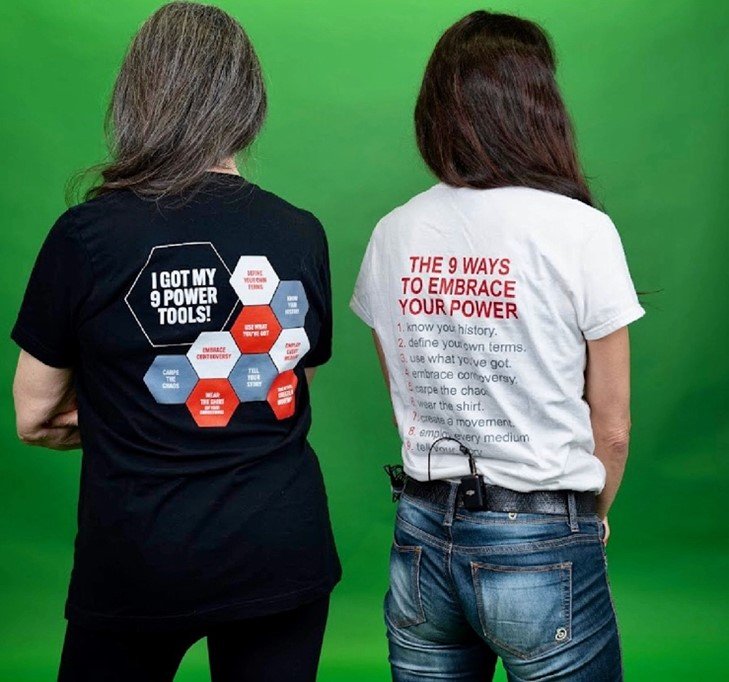
Yes, that’s me on the left with Take The Lead advisor Maggie Sanchez both of us clowning around with our Power Tool shirts.
The first tool is “Know your history and you can create the future of your choice.” I have a long list of women who have been written out of history.
Examples on this graphic, in addition to Hedy, top left:
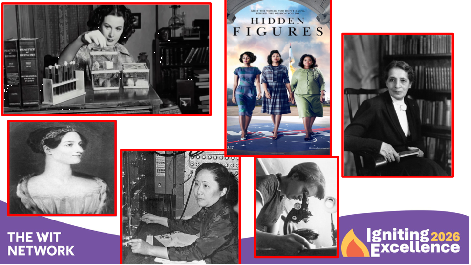
Ada Lovelace (bottom left) created algorithms that underpin computer science today. Charles Babbage who she worked with claimed credit for it.
Katherine Johnson, Dorothy Vaughn, and Mary Jackson, the “Hidden Figures” or human computers as they were called, solved complex problems for NASA space missions, but weren’t known until the book about them was written, and later the movie.
Rosalind Franklin (looking into microscope) discovered the structure of DNA, but her male colleagues James Crick and Francis Watson took credit for it and received a Nobel prize.
Lise Meitner (top right), nuclear fission, same pattern—she discovered the key elements, male colleagues received a Nobel. She was ignored.
Chien-Shieung Wu (bottom middle), was dubbed “queen of nuclear research” for her discoveries, yet her male colleagues received the credit—and the Nobel.
Innovation didn’t lack women. History’s bias lacked recognition.
Personally, I love new technologies and tend to be an early adopter. But I have none of the technology skills the rest of you have. I’m here as someone whose life’s work has been to achieve equality for women.
I enjoyed previous speaker Gavriela Schuster’s recap of women in the 1970’s. Because for me it wasn’t history, it was my life.
And I had to learn everything I know about leadership on the job because when I grew up in small Texas towns, girls weren’t encouraged to be leaders, or even to have careers outside the home.
That inherent unfairness is why I am obsessed with balancing gender in leadership of technology and especially in AI right now.
When I first learned Hedy Lamarr’s story, it felt familiar.
I thought it was just me. But when I started Take The Lead, I heard the same thing from almost every woman.
They would state an idea in a meeting. Crickets.
Ten minutes later a man would repeat the same idea.
Everyone would respond as though it was brilliant.
This phenomenon has a name. And It is larger than not being heard in a meeting. It is literally being ignored or consciously erased from history.
It’s called The Matilda Effect.
The Matilda Effect is named for Matilda Joslyn Gage, who in the 1870’s described the phenomenon of women’s inventions and discoveries being erased or men taking credit for them.
Matilda was a suffragist and mother-in-law to L. Frank Baum. She influenced his famous book The Wizard of Oz and is responsible for the undercurrent of feminism in his books. Notably, Dorothy is the smart one and the leader who unmasks the wizard.
We must fix the erasure of women and we can. Here’s where we start:
Women hold less than 25% of senior leadership roles in technology, compared to about 30% average across all sectors, and only 22% in AI, which by the way is being adopted 35% of women vs 45% of men. Compounded over time, these disparities have serious consequences.
For women:
fewer role models
fewer sponsors
slower advancement
For families:
fewer women reaching income levels that build generational wealth
For companies:
fewer perspectives shaping innovation and-drum roll-lower profits
This isn’t a law of physics. It’s a leadership problem. And leadership problems are solvable.
We are living through one of the biggest technological revolutions in history.
Every technological revolution reshapes power. The people who lead these revolutions shape the world.
That’s why your leadership is so important.
So here are three leadership moves that can make all the difference:
1. Know Your Power and use it.
You have the power. I never say I am empowering women, because we are not vessels to be filled. We are the source of our own supply. We have been earning 2/3 of the college degrees for decades, so we have the power of education. We buy 80% of consumer goods and services, so we have the power of the purse. The business case is clear that companies with more women in leadership are more profitable. But it’s up to us to embrace our power.
If you remember nothing else today, remember that power unused is power useless.
If you have an ambivalent relationship with power, as I found many women do in my research for my book No Excuses, understand that power is like a hammer. You can break things or build with it.
I encourage you to change the definition to one you like, from “power over” which is oppressive to “power TO” which is generative and innovative and creative.
Power over assumes scarce resources so we have to fight over the crumbs. Power TO knows that in an economy based on brains not brawn, resources like intelligence, creativity, empathy, and innovation are infinite. There is no finite pie, plus we can make more pies.
So identify your points of power—what do you bring to the table? Is it knowledge? Skills? Experience? Access to funds? Relationships? Make a conscious decision to use them.
2. Name and Claim Your Intention
Intentions are decisions about how you will use your power and make it visible so that it compounds. For example:
Before you go into a meeting where you want your idea to be heard and considered, make sure you have had the meetings before the meeting to engage your allies, male or female. Line up support in advance and learn where the pushback might be. Pro tip: rehearse with two or three trusted women who will be in the meeting so they are primed to support you. And be sure to reciprocate when it’s their turn.
And if a man gives your idea after you already said it, be sure to thank him for supporting you in a voice everyone can hear.
3. Make Tomorrow’s History: Use the power of your voice to make sure women’s technological innovations are known, seen, and heard.
Like these technology innovators and leaders:
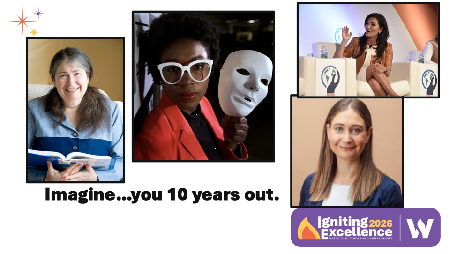
Radia Perlman (“mother of the internet”), Joy Bulamwini (discovered AI couldn’t read black faces and lifted up the problem of racial and gender bias in AI), Nina Vaca (founded largest Latina owned IT company), Daniela Amodei (cofounder and president of Anthropic).
Now, imagine it’s 2036.
Technology has transformed the world again. Imagine the breakthrough that changed everything.
And the person behind it…is a woman who was sitting in this room today.
Maybe she built the company.
Maybe she invented the system or the product.
Maybe she led the team that made it happen.
That future is not a fantasy. It is a leadership decision to create it.
And somewhere in this room today…someone is already working on the next breakthrough the world will depend on. Maybe it’s you.
Few people know the name Hedy Lamarr except as a beautiful actress. You can redeem her and the many women who were written out of history.
My call to you is to make tomorrow’s history today, intentionally.
Build the technology or company that is your heart’s passion.
Claim the leadership by bringing your superpowers as a woman.
And use the power of your voice to tell your story and other women’s stories to make sure history remembers your name.

GLORIA FELDT is the Co-founder and President of Take The Lead, a motivational speaker, and a global expert in women’s leadership development and DEI for individuals and companies that want to build gender balance. She is a bestselling author of five books, most recently Intentioning: Sex, Power, Pandemics, and How Women Will Take The Lead for (Everyone’s) Good. Honored as Forbes 50 Over 50, and Former President of Planned Parenthood Federation of America, she is a frequent media commentator. Learn more at www.gloriafeldt.com and www.taketheleadwomen.com. Find her @GloriaFeldt on all social media.