
Smile More, Kaitlan. No, Smile Less. Which Is It?
Issue 2874— February 9, 2026
Lives there a woman who has not been told many times over, “Smile more.” And/or “Smile less.” Count yourself either lucky or oblivious if you said, “Me.”
This video posted by CNN reporter Kaitlan Collins got me going on the impossible Catch 22 that every woman lives in almost every aspect of life.
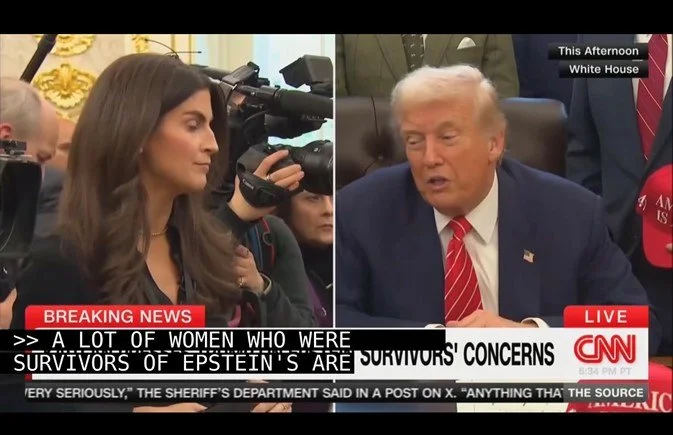
I was impressed with the calm, focused way Kaitlan responded to what had devolved into the most personal, and most frequent, of gendered attacks, a typical reaction to women who cross powerful men.
I posted: “Go @kaitlancollins! Use the power of your voice and your platform to get the truth out. You faced off a classic example of how someone with no defense uses deflection, gaslighting, lying, and if all else fails, personal attack to avoid responsibility.”
There is nothing that makes a powerful man angrier than a woman who stands her ground, especially if he is in the wrong.
Kaitlan’s behavior was a model for staying true to her professional mission and maintaining her personal power.
As host of CNN’s “The Source with Kaitlan Collins,” she then used her platform to make sure more people saw the truth of how she was treated. She told her story dispassionately and factually. The video evidence is clear. She did not need to make accusations to get her point across.
A wise journalist friend once cautioned me, “Never get into a fight with someone who buys ink by the barrel.” If you remember the days of thick paper newspapers, this will have meaning for you. Today, we might say, “Don’t get into a fight with someone in control of the mouse. Or the iphone. Or who hosts her own television show.”
Kaitlan used the power of her voice with dignity and strength.
Her journalist colleagues? Not so much. Why didn’t they back up her perfectly reasonable questions? That’s a question for another day but one that warrants consideration.
Smile more. No, smile less.
I smile a lot. I’ve been told all my life to smile to make myself more likeable and, as a result, more trustworthy.
Still, though I showed up in conservative professional attire for my first media training and thought I had modulated my countenance appropriately to the situation, the (male) consultant from the US Chamber of Commerce told me not to “come across as such a pushy broad" and—yes—to smile more.
Not only was his advice disrespectful, there is significant evidence that commanding women to smile or modify their presence in general can negatively affect their job performance. That’s not a reflection of their capabilities or ambition but comes from a feeling of loss of agency and dissatisfaction with the organizational leadership for which they work.
According to this 2003 research by Yale University Professor Marianne LaFrance, women typically do smile more than men, due to socialization to be accommodating.
But when women and men hold similar work and social roles, that difference disappears. Why is that?
To understand the phenomenon, it is necessary to probe the power play at work when women are told to adapt their behavior to a style that doesn’t upset the men in charge.
The most dramatic archetype for a culture of male hegemony of the most toxic kind could be Jefferey Epstein and his enablers. They created a world ruled by men’s primal sexual desires, practiced in broad daylight with no accountability, because his buddies were complicit.
As many of his survivors are describing, this hell was enabled by avarice, unfair (and not always even real) access to wealth and power, and a culture justifying “boys will be boys” behavior without regard to who gets hurt.
And the complicit women? That logic becomes obvious in the face of masculine power and privilege. Some women and men as well will always believe they are safer in that space—until they’re thrown aside when they are no longer deemed valuable.
Notice that nobody tells the men to smile more.
So where does this end?
An optimistic Liz Plank (her handle is @feministfabulous) wrote in her Substack post entitled, “We are living through patriarchy’s last tantrum,” that: “We are living inside a distorted system, and we are watching it reach its final stage. That’s destabilizing, but it’s also clarifying. You don’t need to burn it down or save it or have the next world fully imagined. You just need to remember that the fire you’re watching isn’t inside you. It’s the system, finally burning down to the ground.”
That rosy conclusion is possible but not inevitable. Many prognosticators (including myself at times) have prematurely declared the last misogynistic gasp of the patriarchy.
Looking at history, we might as well realize that though it can take different forms, misogyny comes roaring back to try to push back women’s every major advance.
To counteract that, women must not react defensively. Instead we must use our power to amass our strengths by supporting each other, declare our vision of a fairer and more sustainable world, gird our loins for the inevitable conflicts, and push forward with all the intention we can muster.
If you want help mastering these and other important strategies, join me for the 9 Leadership Power Tools virtual course and community of like-minded women.
And take a lesson from Kaitlan.
Smile all you want.
Or don’t smile.
Do what’s authentic to you. Do it with integrity.
Pay attention to useful feedback. But don’t let someone else’s power play take up space in your mind.
Stay focused on your intention and the world will return the respect you rightly deserve.
GLORIA FELDT is the Co-founder and President of Take The Lead, a motivational speaker, and a global expert in women’s leadership development and DEI for individuals and companies that want to build gender balance. She is a bestselling author of five books, most recently Intentioning: Sex, Power, Pandemics, and How Women Will Take The Lead for (Everyone’s) Good. Honored as Forbes 50 Over 50, and Former President of Planned Parenthood Federation of America, she is a frequent media commentator. Learn more at www.gloriafeldt.com and www.taketheleadwomen.com. Find her @GloriaFeldt on all social media.