
The Skies Aren't Equal. Get Women Into Aviation, Aerospace, Airlines
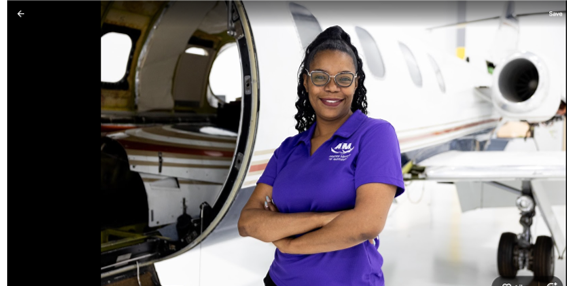
Tiffini Coleman is a senior instructor of Aviation Institute of Maintenance.
“Look, up in the sky. It’s a bird, it’s a plane maintained by all female aviation mechanics!”
That could be the latest declaration as the Aviation Institute of Maintenance, America’s lagest network of aircraft maintenance technician schools, is partnering with American Airlines, United, British Airways and other sponsors, to bring more girls and women into aviation, aerospace and STEM.
Tiffini Coleman, AIM lead head instructor and alumna, has a mission bigger than any plane in the sky. “Society tells women that we are better at supporting roles. They don’t teach women that we are enough, but we have to leave old stereotypes in the past.”
“Society tells women that we are better at supporting roles. They don’t teach women that we are enough, but we have to leave old stereotypes in the past.” Tiffini Coleman, @AviationInstituteMaintenance ”
The numbers of women in several levels of aviation are improving, but they are still extremely low.
Read more in Take The Lead on women in aircraft engineering
According to United Aviation’s “latest global survey on the status of licensed aviation personnel by gender reveals that the participation of women holding positions as pilots, air traffic controllers, and maintenance technicians has increased on an overall basis from 4.5% globally in 2016, to 4.9% in 2021.”
Breaking that down to airline pilots, “The percentage of women pilots in service increased from 3.6% to 4.0% globally, with the highest increase observed in the Asia Pacific and Latin America/Caribbean regions. North America scored highest globally with 4.6% women pilots, followed by Africa and Europe with 4.1% and 4%,” the survey shows.
Additionally, the study shows, “The percentage of female aircraft maintenance engineers and technicians rose from 2.7% to 3.0% worldwide. The number of women air traffic controllers remained stable globally at around 20.6%, with increases being observed in the Latin America/Caribbean and Middle East regions. The Latin America/Caribbean region featured the highest percentage of women controllers with 31.8%, followed by Europe with 21.4%.”
“Percentage of women pilots in service increased from 3.6% to 4.0% globally, Percentage of female aircraft maintenance engineers and technicians rose from 2.7% to 3.0% worldwide.” #genderinequity #womeninSTEM”
Read more in Take The Lead from an aerospace engineer
The gender gap in aviation has been historic for several reasons.
“Phrases such as ‘trolley dolly’ reinforce negative stereotypes surrounding women in aviation. Indeed, most women in aviation work as members of cabin crew,” Simple Flying reports. “Part of this comes from standardized roles for men and women back in the Golden Age of Aviation. When air travel started, the idea for flight attendants was to provide hospitality in the sky in addition to safety.”
There is also a lack of female airline pilots across the world. A 2018 CAPA study shows slow growth with United having over 900 female pilots, Delta was behind at close to 700, American topped 600. Lufthansa, Indigo, Skywest, and Southwest all had just over 300, but under 400 female pilots. Other major airlines, including British Airways, Air Canada, Air India, KLM, and Cathay Pacific also have a significant share of women pilots,” Simple Flying reports.
Read more in Take The Lead from a female pilot
But there are signs of change with women in airline leadership, even if it is far, far, far away from parity.
“Women are increasingly taking the helm, guiding day-to-day operations and also shaping strategy, sustainability initiatives, and workforce culture. Notable leaders include Joanna Geraghty, the CEO of JetBlue, Vanessa Hudson, CEO of Qantas, and Marjan Rintel, CEO of KLM. These women bring diverse perspectives to an industry where decision-making has historically been homogeneous. Their leadership drives tangible results in innovation, passenger satisfaction, and corporate responsibility,” according to Aerotime.
“Joanna Geraghty, CEO @JetBlue, Vanessa Hudson, CEO @Qantas, Marjan Rintel, CEO @KLM. These women bring diverse perspectives to an industry where decision-making has historically been homogeneous.#womenleadership #airlines”
Still, it will take more than 130 years to close the gender gap in all levels of aviation. An upcoming documentary shot in Chicago and highlighting the efforts of AIM focuses on the need for growth of women in the industry, particularly women in MRO—maintenance, repair and operations.
Read more in Take The Lead on women in aerospace
Recent research published in Nature reports, “Environmental factors such as gendered stereotypes, cultural norms, dynamic information and academic climates have been demonstrated to be the reasons why women are underrepresented in STEM or STEM-related disciplines.”
“@Nature: Environmental factors such as gendered stereotypes, cultural norms, dynamic information and academic climates have been demonstrated to be the reasons why women are underrepresented in #STEM or STEM-related disciplines.”
Aviation and aeronautics are considered STEM fields.
“This is a male-dominated field,” says Coleman, who says the industry will need more than 416,000 aviation engineers in the next eight years. These are spots she intends to fill with many of her female students.
With 15 campuses across America, AIM intends to diversify aviation fields with gender, race and all forms of inclusion.
“We’re trying to saturate the field with young women,” says Coleman,47. “Representation matters. I didn’t see me when I started in this business at 28 years old.”
“Tiffini Coleman @AviationInstituteMaintenance: “We’re trying to saturate the field with young women. Representation matters. I didn’t see me when I started in this business at 28 years old.”
Read more in Take The Lead on women in STEM
A Chicago native, Coleman says as a child, “I took apart everything. I always wanted to know how something worked.” From dismantling the family’s VCR, to working on her father’s car with him, she was the only girl with two brothers and an intense interest in discovering instructions for repair.
With a degree in electrical engineering, Coleman worked in auto mechanics and later for Chicago Transportation Authority, before moving into aviation engineering.
Teaching at AIM since 2023, Coleman says, “I wanted to give back to my community. The way I look at it, I am teaching them to fish. This career has changed my life financially, and it is the best investment you can do for yourself.”
Read more in Take The Lead on filling STEM pipeline
With the goal of diversifying and creating gender equity in aviation, Coleman says, “I want the industry to look like my school. That will help with racism in the industry.”
With many industries facing slowdowns in hiring and shrinking in reach due to the expansion of AI, Coleman says aviation maintenance is AI-immune.
The data and research support that ideal. National Aviation Academy reports, “Unlike many jobs that are susceptible to automation, the job of an Aviation Maintenance Technician calls for a certain set of abilities and expertise that are difficult for AI to imitate. AMTs are in charge of inspecting, repairing, and maintaining aircraft, which calls for the ability to solve complicated problems and make informed decisions. AMTs are extremely valuable in the aviation business and less likely to be replaced by AI because to their unique training and experience.”
Coleman says, “AI cannot do what we do. Humans still have to do it—the troubleshooting, fixing, daily repairs. The only thing the plane does on its own is autopilot cruise mode. No AI will take us over.”
“AI cannot do what we do. Humans still have to do it—the troubleshooting, fixing, daily repairs. The only thing the plane does on its own is autopilot cruise mode. No AI will take us over.” Tiffini Coleman.”
