
The Witch, The Crone, and The Wise Woman Who Runs the Place
Issue 2902 -November 2, 2026
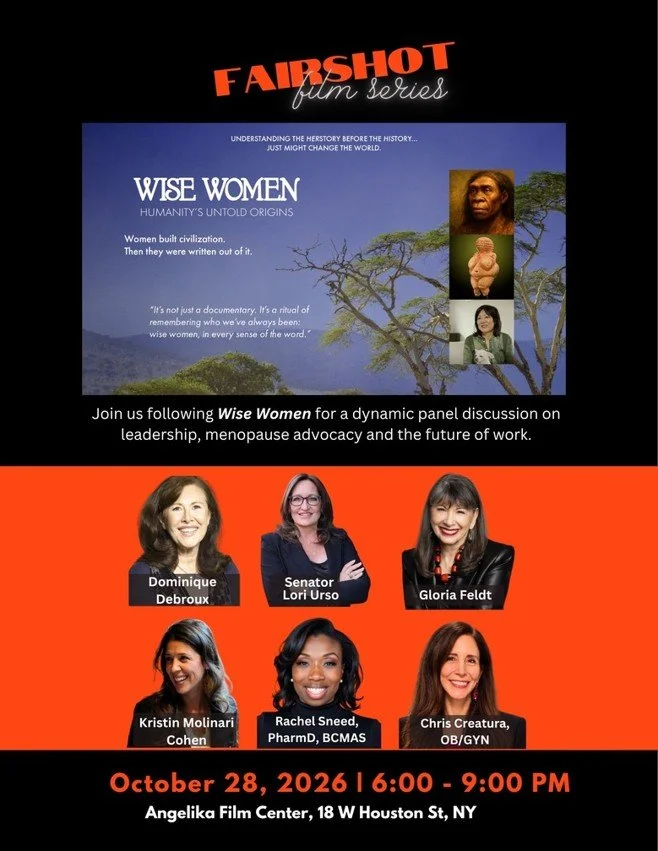
During Halloween’s witching season, I moderated a fascinating panel after screening Wise Women: Humanity’s Untold Origins. The sold out event was sponsored by Gender Fair and Take The Lead.
The film starts with a husband trying to be a decent partner. Chris Henze (the film’s director) wanted to understand what his wife, Dominique Debroux (the film’s producer), was going through in menopause. So he did what curious people do and went looking, asking doctors, philosophers, scientists, and women who’ve been through it like the film’s executive producer comedian Margaret Cho.
He ended up in paleoanthropology, asking why human females live decades beyond their fertility when almost no other mammal does.
The answer the film offers isn’t startling—theories about human society evolving from matriarchal to patriarchal have been around for decades. I used to think they were too woo-woo to be credible. Perhaps that’s because until recently, science has mostly been developed and taught through male eyes.
Here’s the film’s twist: Women past childbearing weren’t leftovers. They were the keepers of knowledge about food, medicine, children and survival. They freed younger women to bear and raise more babies, and they passed the group’s knowledge. The film argues this is how culture, and our big homo sapiens brains that carry it, took hold. It’s a hypothesis, and scientists debate it. But it turns a lifetime of insults on their head.
So here’s the question: If older women helped make us human, how did we get to a world that treats them as invisible, or worse?
Some scholars have long argued that before farming and land ownership, societies were more egalitarian and women held real authority. Once societies organized around owning land, passing property to sons and controlling women’s bodies to guarantee paternity over those sons, women’s value got tied to fertility. When fertility ended, so did the value. A woman past childbearing became a cost, and then a nuisance. A crone, an old hag.
And then she became a threat. That’s the double edge. A woman past childbearing who speaks up, heals, or won’t be managed gets called a witch. Historians estimate there were 40,000 to 50,000 executions of mostly women accused of being witches worldwide in the middle ages. Midwives who knew how to bring babies into the world, or keep them from coming were part of that number because they held knowledge that men’s institutions wanted to control.
Invisible or dangerous, but never simply a person with authority.
And sometimes that limiting belief is in our own heads.
When I was recruited to lead Planned Parenthood Federation of America, the nation’s largest reproductive health and advocacy nonprofit organization, I was 53. I first thought I was too old. Nobody said so. I’d simply absorbed the idea that the time for taking on a big job with a complex organization needing a turnaround leader had passed.
I was wrong. It was the best time of my life. I knew what mattered and what didn’t. I knew how to assess problems quickly, build relationships, and design solutions. My children had left the nest. I had the experience, the judgment, and the courage honed from lived experience.
If the film is right, I wasn’t unusual. I was simply doing what women my age were built to do.
So why is menopause suddenly everywhere?
Until recently, nobody said the word at dinner. Now it’s in medical headlines, billion-dollar startups, and state legislatures. I think there are several reasons, and they feed each other.
The science finally caught up with the fear. For decades, many women were told hormone therapy was dangerous, a belief rooted in early readings of a big study and reinforced by a boxed warning on every label. In November 2025, the FDA removed the black box warning from menopausal hormone therapy products. Clinicians now emphasize timing, formulation and individual risk rather than a blanket warning. A generation of women went untreated because of a label, and that’s now being undone.
Sheer numbers. American women are half the workforce and about 1.5 million of them enter menopause every year. Workplaces are barely ready. Though a growing number of U.S. employers offer menopause-specific benefits, a recent SHRM study found that only about one-fourth do. States are starting to act.
Rhode Island State Senator Lori Urso sponsored the first bill providing accommodations for menopause symptoms in 2025. She was on the “Wise Woman” panel I facilitated, along with Perry’s Chief Strategy Advisor Kristin Molinari Cohen, who had just had her first experience lobbying members of Congress on the topic, Rachel Sneed, a pharmacist who is a medical science advisor for Bayer, and Chris Creatura MD, assistant professor of ob/gyn at Cornell Weill and certified menopause practitioner.
And here’s my additional read on why menopause is so front and center now. The women going through perimenopause and menopause aren’t the women who went through it a generation ago. They’re in boardrooms, newsrooms, and operating rooms. They’re used to being taken seriously, and are not willing to be quietly managed out at the moment they hit their stride. They have platforms and money, and the market noticed.
Silence was never a natural state. It was a rule, and women are breaking it.
The film adds something the medical conversation can’t. Treating symptoms is real and necessary. But if menopause is seen as a malfunction to fix, we’ve kept the old story. If it’s evolution’s investment in women who go on to lead, teach and decide, then it’s a transition worth honoring.
What do we do?
First, we change the story. Midlife and beyond isn’t a decline we must manage. It’s when many of us come into our full power.
Say it, show it, and refuse to apologize for it.
Second, we use our power on our terms. Power over is the old model, dominating others. Power to is the capacity to get things done. Women in their fifties, sixties and beyond hold more of the second kind than any generation before us. We vote, we hold money and institutional knowledge, and we know where the bodies are buried. Put us in the boardroom, the legislature, and the executive suite, then pay attention to what changes.
Third, we stop letting the choice be false. Real support for caregiving, childcare, paid leave, menopause, and fair pay turns “I have to leave work” into “I choose to.” Until then, the word “choice” is a lie.
Finally, we refuse both labels. We’re not invisible and we’re not dangerous except to those who fear losing their unearned privilege.
We’re the ones who’ve been holding it all together since long before anyone wrote history down.
We proudly wear the “Wise Women” shirt.
Here’s an opportunity for you. At Take The Lead’s Power Up conference, we featured a panel “The Audacity to Thrive: Women Claiming Midlife Health and Power.” The conversation was so rich and informative that we’re bringing it back by popular demand. Join us for a replay of the panel plus a live Q&A on November 16 at 7pm ET to get your questions answered by Jennifer Weiss Wolf, Executive Director of the Birnbaum Women’s Leadership Center at NYU Law and author of the new bestselling book When in Menopause. Everyone who attends will have a chance to win a copy of Jennifer’s book and one of her really cute t-shirts. Everyone who registers will get the replay. SIGN UP HERE.
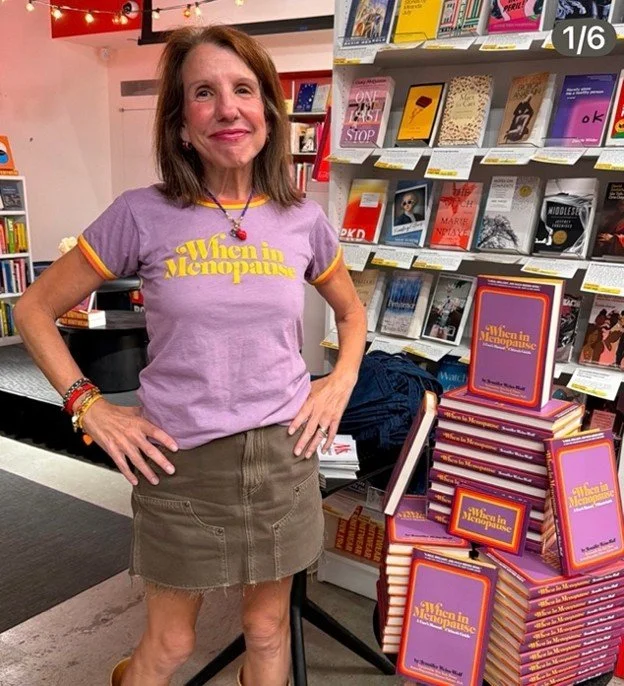
Jennifer Weiss Wolf, author and Executive Director of the Birnbaum Women’s Leadership Center at NYU Law.
GLORIA FELDT is the Co-founder and President of Take The Lead, a motivational speaker, and a global expert in women’s leadership development and DEI for individuals and companies that want to build gender balance. She is a bestselling author of five books, most recently Intentioning: Sex, Power, Pandemics, and How Women Will Take The Lead for (Everyone’s) Good. Honored as Forbes 50 Over 50, and Former President of Planned Parenthood Federation of America, she is a frequent media commentator. Learn more at www.gloriafeldt.com and www.taketheleadwomen.com. Find her @GloriaFeldt on all social media.