
Justice Doesn’t Bend Itself: What the Civil Rights Movement Taught Me About Leadership
Issue 2872— January 19, 2026
In recent years, it had become easy—like it has for many Americans—to treat long weekends meant to honor a national hero as a pause button: a little extra sleep, a short family trip, catching up on errands or unfinished work.
Even the ordinary feels out of place this year.
As I write this, my refrigerator is on the blink, and I’ll likely spend part of MLK Day waiting for a repair person, hoping the appliance can be saved. It’s a small, mundane disruption—but it feels oddly symbolic. When the world is at a moral crossroads, even routine things feel unsettled.
And we are at a moral crossroads.
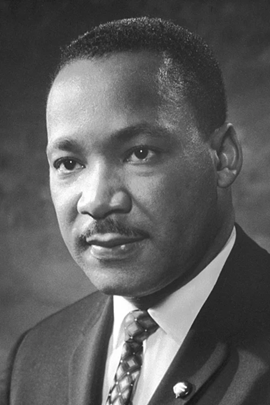
We will soon find out whether Dr. Martin Luther King, Jr.’s belief that “the arc of the moral universe bends toward justice” proves true—not because the arc bends on its own, but because leadership shows up to bend it.
I owe much of my life’s path, and almost everything I believe about leadership, to my early experience with a Civil Rights organization during the fight to desegregate schools and places of business.
This was in Odessa, Texas—hardly fertile ground for racial justice organizing at the time. I was young. I held no title. I had no formal authority. To this day, I don’t even remember how I was invited into those meetings.
But I am profoundly grateful I was.
Because that’s where I learned my first leadership lesson: change is possible and leadership does not wait for permission to make change happen.
The Civil Rights Movement taught me that change is possible—even when it seems impossible—when people of shared purpose come together with vision and persistence. Even without formal power, collective leadership can transform norms that were once dismissed as immovable: segregated schools, segregated lunch counters, entire systems justified by “that’s just how it’s always been.”
I think about that often when the moment feels dire. There is always a way forward when people decide not to accept injustice as inevitable.
The movement taught me something else, too—something that shaped the rest of my life.
As I watched closely, I noticed that women were doing much of the grueling, behind-the-scenes work that made the movement function, while men most often assumed the visible leadership roles and received the recognition.
It was an awakening.
I realized that even movements committed to justice can replicate inequality—and that if there are civil rights, then women must have them too.
That insight changed everything.
I knew, even then, that I would devote my life to women’s equality, though I had no idea what form that work would take. I certainly couldn’t have imagined founding Take The Lead. At that point, I didn’t even think of myself as a leader.
But I did understand something essential: racism, sexism, antisemitism, homophobia, and other forms of prejudice are joined at the head. We will succeed or fail together in confronting injustice.
Dr. King often reminded us that while the arc bends toward justice, it is long. History has taught me something else: how long that arc is depends on leadership.
A leader is someone who gets things done.
Leadership is not about titles or privilege. It is about the courage to act on your values—especially when doing so is uncomfortable, unpopular, or risky. It is about speaking truth to power misused, even when your voice shakes, because silence costs more than fear.
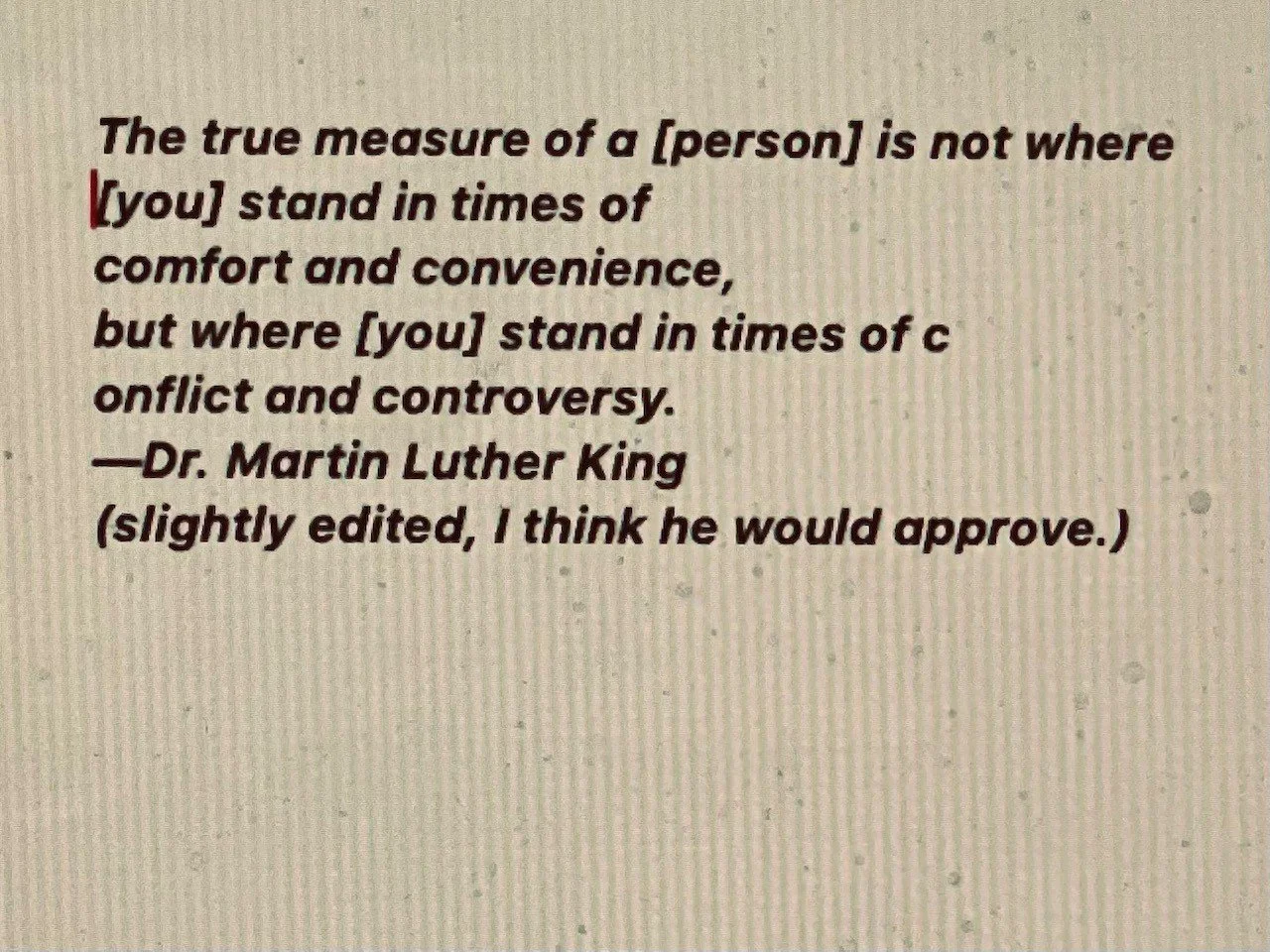
Years later, when I was president of Planned Parenthood and facing violence against women’s reproductive health providers, one of my mentors said something that has stayed with me ever since: “The fastest route to self-esteem is to stand up for what you believe.”
In fighting for the rights of others, I slowly learned how to claim—and defend—my own.
That lesson mattered deeply to me as a woman raised to be agreeable, quiet, and unaware of my own power. It mattered as someone who grew up in the cotton-growing part of Texas, culturally tied to the Deep South. And it mattered to me as a Jewish woman, one generation removed from relatives lost in the Holocaust, who learned early what it feels like to be othered—even when you outwardly “blend in.”
I didn’t know how to speak up then. But the Civil Rights Movement gave me a framework for courage.
Dr. King and the countless courageous women and men who led beside him showed us that justice requires not rage alone, but strategy; not bitterness, but discipline; not despair, but dignity.
I recommend watching the documentary “The Dirty Work” on former Atlanta Mayor, Congressman, and ambassador to the UN Andrew Young’s role in the movement’s leadership.
Young—who stood beside Dr. King when he was assassinated—recalled his father’s advice in the face of injustice: “Don’t get mad. Get smart.” Dr. King echoed that wisdom when he urged us to pursue freedom without hatred, and to conduct our struggle on “the high plane of dignity and discipline.”
That message feels urgently relevant today.
We do not honor Dr. King by quoting him. We honor him by leading with his principles.
Leadership is how justice moves from idea to action. And women’s leadership is not a side issue—it is central to completing the work the Civil Rights Movement began.
This MLK Day, I hope we do more than remember a hero. I hope we ask ourselves what kind of leaders this moment requires of each of us. What words, actions, or teachings of Dr. King most inspire you today?
May they guide us—not just to reflect, but to act—for our own good, for the good of the world, and for good as in forever.
GLORIA FELDT is the Co-founder and President of Take The Lead, a motivational speaker, and a global expert in women’s leadership development and DEI for individuals and companies that want to build gender balance. She is a bestselling author of five books, most recently Intentioning: Sex, Power, Pandemics, and How Women Will Take The Lead for (Everyone’s) Good. Honored as Forbes 50 Over 50, and Former President of Planned Parenthood Federation of America, she is a frequent media commentator. Learn more at www.gloriafeldt.com and www.taketheleadwomen.com. Find her @GloriaFeldt on all social media.