
Who Is The Madwoman at The River’s Edge?
Issue 2889 -June 22, 2026
I’d wanted to go to Greece for years.
So when my friend Jamia Wilson invited me to a writer’s retreat she was co-facilitating with Narrative Healing founder Lisa Weinert on the beautiful island of Kythera, I enthusiastically signed up.
Kythera is famous for its beaches and mountains, its honey and curative herbs—and as the birthplace of Aphrodite, the goddess of love, desire, and beauty.
According to myth, she rose from the seafoam fully formed, fully powerful, fully herself.
Yet while they had their goddesses as well as gods, the ancient Greeks, like some today, were not always generous to powerful women.
Notably, the word hysteria comes from the Greek hystera — uterus. The idea was as simple as it was brutal: a woman who stepped outside her prescribed role was not applauded. Her uterus had wandered. She was sick.
When the virgins of Argo refused to comply with male authority and fled to the mountains, the physician Melampus declared them mad and “cured” them by sending them back to men. And a 2,500-year diagnosis started long before Sigmund Freud.
The diagnosis had one purpose: silence.
Hysteria was the label applied to any woman who rebelled — who had opinions that contradicted the men in power, who claimed rights society hadn’t granted her, who told a truth no one wanted to hear.
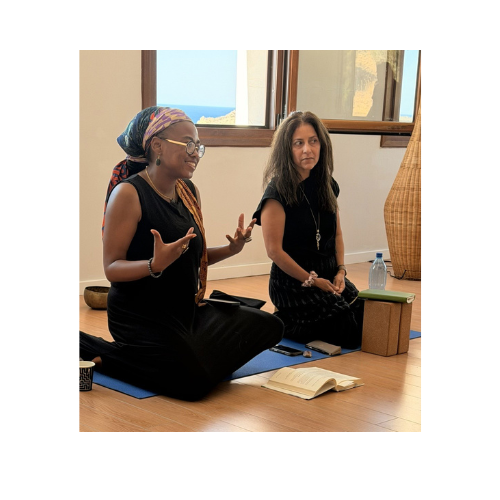
Jamia Wilson (left) co-facilitating a writer’s retreat, Narrative Healing, with founder Lisa Weinert (right) in Greece.
Call her crazy. Lock her up. Problem solved.
Does this ring familiar? Maybe you have seen or experienced this phenomenon?
As the late Jane Goodall famously said, “It doesn’t take much to be considered a difficult woman. That’s why there are so many of us.”
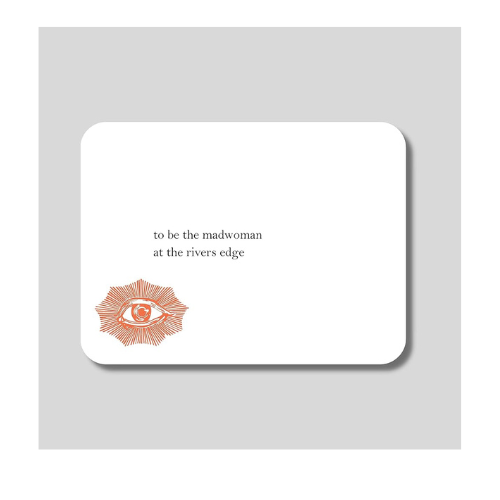
One morning at the retreat, Jamia used a deck of Lucille Clifton’s quotes to ignite the conversation. I drew a card that said: to be the madwoman at the river’s edge.
That phrase took my breath away.
I thought of what women considered mad looked like across the centuries, yet what they have accomplished.
And why I say being called the madwoman can be our badge of honor.
She disagreed with her husband. He had her committed.
In 1860, Elizabeth Packard — a minister’s wife in Illinois — began teaching Sunday school with her own religious views rather than her husband’s. He had her committed. No hearing. No evidence legally required.
A doctor testified she was “hopelessly insane.” Her refusal to agree she was crazy was itself considered a symptom of her craziness.
When she finally got a jury trial, they deliberated seven minutes before declaring her sane. Seven minutes to undo three years.
Packard went on to become one of the most effective legal reformers of the 19th century, winning new protections for women and the committed.
The woman they locked up as mad changed the law for all of us.
She spoke in public while Black and female. They called her a fanatic.
In 1851, Sojourner Truth — born enslaved, self-taught, and formidable — arrived at the Ohio Women’s Rights Convention in Akron. Organizers who feared repercussions from the same oppressors who disputed their cause begged the chair not to let her speak.
She spoke anyway. She dismantled, point by point, every argument made for women’s inferiority — with logic, humor, and a moral force that left the audience in tears.
Newspapers described women who spoke publicly as “brazen female fanatics.”
Men threw rotten vegetables at female speakers. One was hit with a prayer book hurled from the crowd. The madwoman speaks. The “sane” men throw things.
The river flows on. History remembers Sojourner Truth’s name. It does not remember theirs.
She wanted to vote. They called it a mental disorder.
The women’s suffrage movement in the early 1900’s suffered similar disrespect and sometimes violence and incarceration.
Wanting the vote was a symptom, an aberration of the natural order. Silence and compliance were the virtue. President Grover Cleveland said, “Sensible and responsible women do not want to vote.”
Today, the world they fought for — the one where women vote, own property, run companies, run countries — is the one we live in.
She told the truth about a powerful man. They tried to make her seem crazy.
In 2017, actress Rose McGowan accused Harvey Weinstein of rape. For years she was dismissed as unstable, dramatic, unhinged.
Then a memo surfaced — written by Weinstein’s attorney and addressed to her client. It read: “We can place an article regarding her becoming increasingly unglued, so that when someone Googles her, this is what pops up, and she’s discredited.”
Not wrong. Not lying. Unglued.
It is a very old trick.
And it keeps working — until it doesn’t.
McGowan spawned a movement that asserts even powerful men can be held accountable.
In April 2026, a young lawyer named Cheyenne Hunt took the next step.
Hunt had heard whispers about Congressman Eric Swalwell for years — the warnings on Capitol Hill that cautioned women to avoid him, to stay off his radar, to say nothing. She knew the cost of speaking. She spoke anyway. She used her platform to find the other women, to connect them with journalists, to make the story too large and too documented to bury.
When she posted her first video, she wrote: “Having this conversation publicly makes me a liability. But I do not believe in holding one party to a different standard than we hold ourselves. No more predators in power, from either party. Period.”
Swalwell, who denies the charges, nevertheless resigned from Congress days after the story broke.
The so-called madwoman spoke. The powerful man fell.
Now compare what happens to men who break the rules.
Isaac Newton secretly practiced alchemy for years — trying to turn metal into gold, chasing the elixir of immortality — while simultaneously inventing calculus and defining the laws of gravity. He once stared directly at the sun until he nearly went blind, just to see what would happen. History calls this eccentric genius. He got a knighthood and his face on the British pound.
I think of Apple’s “Think Different” campaign: “The people who are crazy enough to think they can change the world are the ones who do.” It attributed this idea to Steve Jobs and the invention of the iphone.
Men who deviate get called eccentric or brilliant. Women who deviate get committed, dismissed, or destroyed.
The name changes. The game never does.
That’s why the card I pulled from the deck seems so relevant.
I know this: the madwoman went to the river on purpose — because the river tells the truth.
A river does not negotiate with the landscape. It doesn’t ask permission to flow. It finds the path forward, carves its own channel, wears down stone — not in one dramatic moment, but relentlessly, stubbornly, over time.
The madwoman stands at the bank because from there, she can see what the people in the center of town cannot: the current. She sees what’s coming. She knows that you cannot stop a river by pretending it isn’t there.
Every woman I know who has ever led anything — a movement, a company, a conversation that needed to happen — has stood by that river. She has been told her ambition is pathological, her anger irrational, her vision delusional. She may have been called hysterical, difficult, unhinged, unglued — in 450 B.C. and in 2017 and in 2026 and everywhere in between.
And she stood there anyway. That is not madness.
That is the bravest thing a person can do.
Elizabeth Packard changed the law. Sojourner Truth changed the conversation. Rose McGowan broke open an industry. Cheyenne Hunt gave young women a path to be believed.
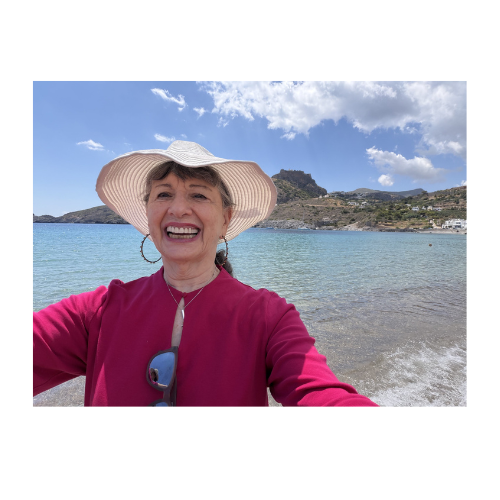
Here I am on my way to the writers retreat, Narrative Healing, on the Greek island of Kythera.
So here is my invitation — my challenge — to you:
Embrace the madwoman in you. Stand by the river. See the current. Say the true thing. The one you’ve been swallowing because the room wasn’t ready. The room is never ready. Say it anyway and it will get ready.
This August 26th, Take The Lead’s Power Up Conference comes to Washington, D.C. I’m excited to share that Cheyenne Hunt will be in the room, in conversation with nearly a thousand women ready to dream, do, and speak their truth.
Minda Harts, Heather Florio, Kelsey Nicole Nelson, BETTY, Dr. Lily McNair, Margaret Atwood, Dr. Rachel Rubin, myself, and other leaders and legends will be there too, speaking truth about AI, career pivots, wealth building, caregiving, making the workplace work for women, and much more.
I am perfectly happy to be called a madwoman at the river’s edge.
That is not a burden. It is a credential.
And this is a conference that helps you embrace the power that belongs to you — your voice, your seat, your place at every table that matters.
Come be a madwoman with us.
GLORIA FELDT is the Co-founder and President of Take The Lead, a motivational speaker, and a global expert in women’s leadership development and DEI for individuals and companies that want to build gender balance. She is a bestselling author of five books, most recently Intentioning: Sex, Power, Pandemics, and How Women Will Take The Lead for (Everyone’s) Good. Honored as Forbes 50 Over 50, and Former President of Planned Parenthood Federation of America, she is a frequent media commentator. Learn more at www.gloriafeldt.com and www.taketheleadwomen.com. Find her @GloriaFeldt on all social media.